Last updated on September 9th, 2026 at 05:56 am
You’re scrolling through TikTok comments or texting a friend when you see someone type “FAFO.” No explanation. No context. Just those four letters.
Now you’re stuck wondering what it means. Is it a joke? An insult? A warning?
That confusion is exactly why so many people search for fafo meaning right now. The phrase has exploded across social media, gaming chats, and everyday texting.
People drop it in comments, captions, and memes, but the tone can change depending on how it’s used.
Sometimes it’s funny. Sometimes it’s a bold warning. And sometimes it’s a way to say, “You asked for this.”
In this guide, you’ll learn the real meaning of FAFO, how people use it in conversations, when it sounds playful, and when it can feel harsh. By the end, you’ll know exactly how to read it, reply to it, and decide if you should use it yourself.
What Does “FAFO” Mean in Text?
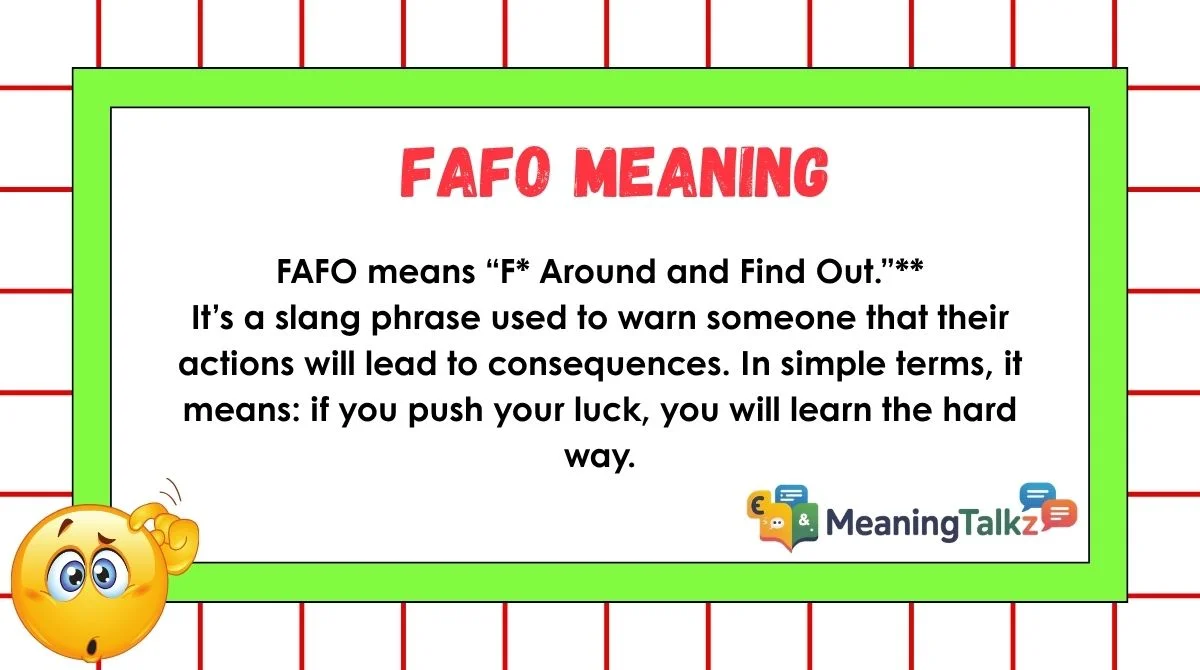
FAFO means “F* Around and Find Out.”**
It’s a slang phrase used to warn someone that their actions will lead to consequences. In simple terms, it means: if you push your luck, you will learn the hard way.
Common interpretations include:
- A warning before someone makes a bad choice
- A confident response to a challenge
- A sarcastic comment when someone ignores advice
- A meme phrase used in jokes or online drama
The tone depends heavily on context.
Can “FAFO” Be Used as a Verb?
Yes. Although FAFO is usually seen as a reaction or warning, it can also be used as a verb in informal online language. Dictionary.com records forms such as “FAFOed” and “FAFOing,” meaning someone engaged in risky or provocative behavior and experienced the consequences.
For example:
“He ignored every warning and FAFOed.”
“She kept pushing the issue and ended up FAFOing.”
The meaning is essentially learning the hard way through your own actions.
This usage is much more casual than standard English, so it fits best in texts, memes, social media comments, and conversations between people who understand the slang. It should not be treated as formal vocabulary for professional or academic writing.
What Does “FAFO Moment” Mean?
A “FAFO moment” describes a situation where someone experiences the consequences of a risky, careless, or provocative decision. It is often used after something goes wrong because the person ignored a warning or pushed their luck.
For example:
“He ignored the warning and touched the hot pan. Total FAFO moment.”
“She kept arguing with everyone and then got kicked out. FAFO moment.”
The phrase is often humorous in memes and comment sections, especially when the consequences are minor or predictable. However, calling something a FAFO moment can sound insensitive if the situation involves serious harm or genuine distress.
In simple terms, FAFO is the warning or reaction, while a “FAFO moment” is the situation where the consequences actually happen.
The Most Common Meanings of “FAFO”
1. A Warning About Consequences
The most common use of FAFO is as a warning.
It tells someone that if they keep doing something risky or annoying, they will face the results.
Example:
Friend:
“I might message my ex again.”
Reply:
“Go ahead. FAFO.”
The meaning here is clear: don’t complain later if things go wrong.
2. A Confident Challenge
Sometimes FAFO is used like a challenge.
It signals that someone is ready to defend themselves or prove a point.
Example:
“Try stealing my fries again. FAFO.”
In this case, the phrase carries a playful but confident tone.
3. A Meme or Joke
Online, FAFO is often used in funny posts or memes.
People use it when someone ignores obvious advice.
Example:
Post:
“He touched the hot pan after everyone said not to.”
Comment:
“FAFO moment.”
Here, it’s more humorous than aggressive.
4. A Reaction to Karma
Another common use is when someone faces consequences after making a bad decision.
Example:
“He skipped studying and failed the exam.”
Reply:
“FAFO.”
The message is simple: actions lead to results.
How “FAFO” Is Used in Real Conversations
Friends & Casual Texting
Among friends, FAFO is often playful.
People use it jokingly when teasing each other.
Example:
Friend:
“I’m about to prank you.”
Reply:
“FAFO.”
Here it sounds more like playful trash talk.
It can also show confidence during friendly arguments.
Example:
“You think you can beat me in Mario Kart?”
“Race me. FAFO.”
Instagram & Snapchat
On social media, FAFO often appears in:
- meme captions
- reaction comments
- story replies
Example captions:
“People who ignore red flags always FAFO.”
Or:
“Told him not to do it. He did it anyway. FAFO.”
Because platforms move fast, short slang like this spreads quickly.
Dating Apps
On dating apps, FAFO can feel bold or sarcastic.
Example:
Bio line:
“Don’t waste my time. FAFO.”
In this case it signals strong boundaries.
But tone matters. Some people may see it as confident, while others may see it as aggressive.
Gaming & Online Communities
Gaming chats love competitive slang, and FAFO fits perfectly.
Players use it when challenging opponents.
Example:
“You think our team is weak?”
“Push the base. FAFO.”
It adds drama and confidence during matches.
It can also appear after someone loses.
Example:
“They rushed solo and got eliminated.”
“Classic FAFO.”
Work or Professional Chat
In professional settings, FAFO is usually avoided.
The phrase includes profanity, even if the letters hide it.
Using it in work chats can seem rude or unprofessional.
Instead, people might say:
- “Actions have consequences.”
- “That decision may backfire.”
The message stays the same without slang.
Is “FAFO” Rude, Flirty, or Offensive?
The tone of FAFO changes based on the situation.
When It Feels Neutral
Among friends or in memes, it often feels neutral or funny.
Example:
“You ate the spicy pepper.”
“FAFO.”
This tone is playful.
When It Feels Rude
If used during arguments, it can sound aggressive.
Example:
“Keep talking like that. FAFO.”
Now the phrase feels more like a threat.
When It Feels Flirty
Sometimes it appears in playful flirting.
Example:
“You think you can handle my sarcasm?”
“FAFO.”
In this context, it feels teasing rather than hostile.
Context Changes Everything
Three factors change how FAFO feels:
- Relationship between people
- Tone of the conversation
- The situation where it appears
The same phrase can be funny with friends but harsh with strangers.
How to Respond When Someone Says “FAFO”
Your reply depends on the tone.
Casual Replies
- “Challenge accepted.”
- “Let’s see.”
- “We’ll find out.”
These responses keep the tone light.
Funny Replies
- “I already did. Lesson learned.”
- “I prefer the ‘find out’ part.”
- “That’s half the fun.”
Humor can defuse tension.
Neutral Replies
- “Good point.”
- “Maybe you’re right.”
- “I’ll think about it.”
These responses calm the conversation.
Professional Replies
If someone uses slang in work chat, stay neutral.
Example replies:
- “Let’s focus on the solution.”
- “We should review the risks.”
- “Let’s avoid unnecessary problems.”
Professional language keeps things respectful.
Common Misunderstandings About “FAFO”
Thinking It’s Always Aggressive
Many people assume FAFO is a threat.
But online, it’s often used as humor.
Context matters more than the words.
Confusing It With Random Letters
Some people think FAFO is just internet nonsense.
In reality, it’s an acronym with a clear meaning.
Once you know the phrase behind it, the message becomes obvious.
Misreading the Tone
Text messages lack voice tone.
A playful FAFO can easily be misunderstood as rude.
This happens often in group chats or comment sections.
Assuming Everyone Knows It
Not everyone understands internet slang.
Older users or people new to social media may have no idea what FAFO means.
That’s why the phrase still confuses many readers.
Similar Slang Terms You Should Know
Internet slang changes fast. Here are other phrases people often use near FAFO.
YOLO – Do something risky because you only live once.
FOMO – Fear of missing out.
Bet – A way to say “okay” or “challenge accepted.”
Cap – Means someone is lying.
No Cap – Means someone is telling the truth.
brutal– A bold or ruthless action.
Main Character Energy – Acting like the star of the story.
Touch Grass – A joke telling someone to go offline.
FAF – Short slang meaning extremely intense or serious.
GG – “Good game,” often used after winning or losing.
Try Hard – Someone who takes games or competition very seriously.
These phrases appear often in the same online spaces as FAFO.
When You Should Avoid Using “FAFO”
Professional Settings
Work emails and office chats should stay respectful.
Slang with hidden profanity can damage your image.
Even if coworkers understand it, it may seem unprofessional.
Cross-Cultural Conversations
Not everyone speaks internet slang.
Using FAFO with people from different cultures can confuse them.
Simple language works better.
Sensitive Situations
Avoid using FAFO when someone is upset or facing a serious problem.
Example:
If a friend fails an exam or loses a job, saying FAFO can feel insensitive.
Kind words are better.
Public Arguments
Online fights already escalate quickly.
Using aggressive slang may make the situation worse.
Neutral language helps calm things down.
Final Thoughts.
Internet slang spreads fast, and FAFO is one of the most viral phrases right now.
At its core, the message behind FAFO is simple: actions have consequences.
Sometimes it’s a joke.
Sometimes it’s a warning.
Sometimes it’s just meme culture doing its thing.
Understanding the tone is the key.
When used among friends, it can feel playful and funny. In arguments or serious situations, it may sound aggressive or disrespectful.
If you see FAFO online, you now know exactly what it means and why people use it. And if you ever decide to use it yourself, you’ll know when it works and when it’s better to keep the message simple.
Smart texting is not just about knowing slang. It’s about knowing when to use it.
FAQs
What does FAFO stand for in texting?
FAFO stands for “F*** Around and Find Out.” It means that if someone keeps doing something risky or annoying, they will face the consequences.
Is FAFO considered rude?
It can be. Among friends it may sound playful, but in arguments it can feel aggressive or threatening.
Why is FAFO popular on social media?
Short phrases spread quickly online. FAFO is easy to type, fits memes well, and expresses a strong message in only four letters.
Can FAFO be used as a joke?
Yes. Many people use it humorously when someone ignores obvious advice and learns the hard way.
Is FAFO appropriate at work?
Usually no. Because the phrase hides profanity, it may seem unprofessional in workplace communication.
Do younger people use FAFO more?
Yes. The phrase is most common among Gen Z and online communities that use modern internet slang.
What is a simple way to explain FAFO?
A simple way to explain it is: “If you keep pushing your luck, you’ll learn the hard way.”
At the provide me Conclusion paragraph.
The phrase FAFO may look confusing at first, but its meaning is simple once you understand it. It’s a modern slang way of saying that choices lead to consequences.
Whether it appears in a meme, a joke between friends, or a warning in an argument, the tone depends on context.
Knowing how and when people use FAFO helps you read conversations more clearly and respond in a smarter way online.