You send someone a message. They reply with just three letters: “ywa.”
Now you pause.
Is it friendly? Is it sarcastic? Did they just thank you… or brush you off?
Short texting shortcuts like ywa are everywhere in modern chats. People use them on Instagram, Snapchat, gaming servers, and even work apps.
The problem is that many of these short forms carry different meanings depending on tone and context.
That’s why thousands of people search for “ywa meaning in text” every month. They want to know if the message they received was polite, passive-aggressive, or just casual slang.
In Gen Z texting culture, small abbreviations can completely change the mood of a conversation. One tiny reply can signal appreciation, sarcasm, friendliness, or even subtle annoyance.
This guide breaks everything down in simple terms. You’ll learn the real meaning of ywa in text, when people use it, how tone changes its meaning, and how to respond the right way without making the chat awkward.
By the end, you’ll never be confused by “ywa” again.
What Does “ywa” Mean in Text?
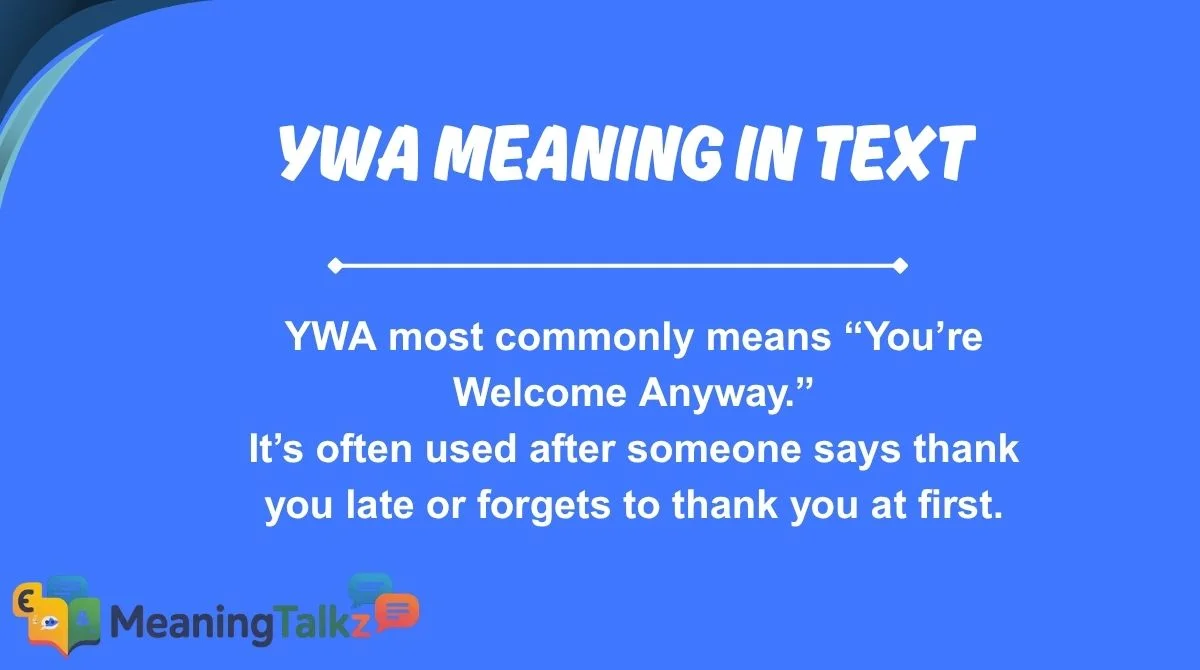
YWA most commonly means “You’re Welcome Anyway.”
It’s often used after someone says thank you late or forgets to thank you at first.
Depending on tone and context, ywa can mean:
- You’re Welcome Anyway
- You Were Asking
- A playful or sarcastic response
- A casual way to acknowledge thanks
In most cases, it’s a short reply that reacts to gratitude or a delayed thank-you.
The Most Common Meanings of “ywa”
Although ywa usually carries one main meaning, texting culture allows several interpretations. Here are the most common ones.
1. You’re Welcome Anyway
This is the most common meaning.
People use it when they helped someone but didn’t receive a thank-you immediately.
Example:
Friend:
“Thanks for sending the notes.”
Reply:
“ywa”
The tone can be neutral or slightly sarcastic depending on the relationship.
2. Light Sarcasm
Sometimes ywa is used when someone ignores help or forgets to acknowledge it.
Example:
You send useful info.
The person never replies.
Later you say:
“ywa I guess.”
In this case, the message carries a playful or slightly annoyed tone.
3. Friendly Acknowledgment
Among close friends, ywa can simply be a relaxed version of “you’re welcome.”
Example:
Friend:
“Thanks for covering my shift.”
Reply:
“ywa anytime.”
Here it’s just casual texting shorthand.
4. Inside Joke Response
In some friend groups or gaming chats, ywa becomes an inside joke.
Example:
Player 1:
“Thanks for the revive.”
Player 2:
“ywa hero moment.”
The meaning stays close to “you’re welcome,” but the tone is playful.
How “ywa” Is Used in Real Conversations
Short slang like ywa behaves differently across platforms. The same letters can feel friendly in one place and rude in another.
Friends & Casual Texting
Among friends, ywa is usually relaxed and harmless.
Example:
Friend:
“Thanks for the ride.”
You:
“ywa no problem.”
Tone here feels friendly and casual.
Sometimes friends also use it jokingly:
Friend:
“You didn’t even say thanks earlier.”
You:
“ywa lol.”
The humor depends on the relationship.
Instagram & Snapchat
On social platforms, people prefer short replies.
That’s why abbreviations like ywa are common.
Example:
Comment reply:
“Thanks for the tag!”
Response:
“ywa”
On Snapchat chats, it often appears after quick favors like sending screenshots or helping with homework.
Dating Apps
Tone becomes more sensitive on dating apps.
If someone says ywa after doing something nice, it might feel slightly sarcastic.
Example:
Match:
“Thanks for recommending that place.”
Reply:
“ywa :)”
Adding emojis or extra words softens the tone.
Without them, it may feel distant.
Gaming & Online Communities
Gaming chats love short replies.
Players often say ywa after helping teammates.
Example:
Player:
“Thanks for the shield.”
Teammate:
“ywa”
The focus is speed, not grammar.
Here it rarely sounds rude.
Work or Professional Chat
In work environments, ywa is not common.
Most professionals prefer full replies like:
“You’re welcome.”
“No problem.”
“Happy to help.”
Using ywa at work may appear lazy or unprofessional.
Is “ywa” Rude, Flirty, or Offensive?
The meaning of ywa depends almost entirely on tone and timing.
When It Feels Positive
It feels friendly when:
- Used between close friends
- Followed by extra words
- Said after someone thanks you
Example:
“ywa anytime.”
That tone feels warm and casual.
When It Feels Neutral
It feels neutral when used as a quick acknowledgment.
Example:
“Thanks for the info.”
“ywa.”
This simply ends the conversation.
When It Feels Slightly Rude
It can feel rude if:
- Someone waited for thanks
- The reply sounds sarcastic
- It appears after silence
Example:
“ywa I guess.”
This signals mild annoyance.
When It Feels Playful
Among friends, it can be joking.
Example:
“ywa I carried the whole team.”
Here it adds humor.
How to Respond When Someone Says “ywa”
If someone sends ywa, your response depends on the situation.
Casual Replies
These keep the conversation friendly.
Examples:
“No worries.”
“Appreciate it.”
“You’re the best.”
“Thanks again.”
Funny Replies
Humor works well with friends.
Examples:
“Wow such kindness.”
“Legend behavior.”
“I’ll remember this forever.”
These keep the mood light.
Neutral Replies
Sometimes no response is needed.
But if you reply:
“Got it.”
“Thanks.”
“Cool.”
These keep things simple.
Professional Replies
If this appears in work chat, keep it polite.
Examples:
“Thank you again.”
“Much appreciated.”
“Glad you could help.”
This maintains professionalism.
Common Misunderstandings About “ywa”
Many people misread this abbreviation.
Assuming It’s Always Sarcastic
Not true.
Most of the time, ywa simply means you’re welcome in short form.
Tone changes meaning.
Thinking It Means “Yeah Whatever”
Some people confuse ywa with dismissive slang.
But “yeah whatever” usually appears as yw or ykw in chats.
Misreading the Tone
Text messages lack voice tone.
That’s why ywa can sound different depending on:
- punctuation
- timing
- relationship
Example:
“ywa” vs “ywa lol”
The second feels friendlier.
Confusing It With Similar Acronyms
Short texting slang often overlaps.
People sometimes mistake ywa for other terms.
Context helps reveal the real meaning.
Similar Slang Terms You Should Know
Understanding related slang helps decode chats faster.
Here are some common ones.
YW
Short for “you’re welcome.”
NP
Means “no problem.”
NBD
Short for “no big deal.”
TY
Means “thank you.”
TYSM
Means “thank you so much.”
IDC
Means “I don’t care.”
IDK
Means “I don’t know.”
TBH
Means “to be honest.”
SMH
Means “shaking my head.”
IMO
Means “in my opinion.”
FR
Means “for real.”
Learning these helps you read modern chats faster.
When You Should Avoid Using “ywa”
Even though ywa works in casual chats, it doesn’t fit every situation.
Professional Settings
Work emails and formal chats require full words.
Avoid:
“ywa”
Use instead:
“You’re welcome.”
Professional tone builds respect.
Cross-Cultural Chats
Not everyone understands internet slang.
International conversations may misinterpret abbreviations.
Using full phrases prevents confusion.
Sensitive Situations
If someone thanks you for serious help, short slang may seem cold.
Example:
Helping during a difficult situation.
Instead of:
“ywa”
Say:
“Of course, happy to help.”
Tone matters.
Final Thoughts.
The meaning of ywa in text is simple once you understand modern messaging culture.
In most cases, ywa means “You’re Welcome Anyway.” It’s a quick reply people send after someone says thank you or acknowledges help.
But like many internet slang terms, its tone changes depending on the conversation. Among friends it can feel playful. In casual chats it feels neutral. In certain moments it may sound sarcastic.
Understanding these subtle tone shifts helps you read conversations more accurately.
The key rule is simple: context always decides meaning.
Once you recognize where and how people use ywa, you can respond naturally and avoid misunderstandings in online chats.
FAQs
What does ywa stand for in texting?
YWA usually stands for “You’re Welcome Anyway.” It’s a short response used after someone says thank you or acknowledges help.
Is ywa a sarcastic response?
Sometimes. If used after someone forgets to say thank you earlier, ywa may carry a light sarcastic tone.
Is ywa rude in text messages?
Not usually. Among friends it’s casual. However, in formal chats it may seem lazy or dismissive.
Where is ywa commonly used online?
You’ll mostly see ywa in text messages, Snapchat chats, Instagram replies, gaming conversations, and casual group chats.
Is ywa the same as yw?
No. YW simply means “you’re welcome,” while YWA often implies “you’re welcome anyway,” sometimes with slight sarcasm.
Should I use ywa in professional conversations?
No. In professional settings, it’s better to say “You’re welcome” or “Happy to help.”
Why do people use ywa instead of full words?
Short slang saves time in fast conversations. Many Gen Z users prefer quick replies instead of typing full phrases.
Conclusion
Understanding ywa meaning in text helps you avoid confusion in modern digital conversations.
While the abbreviation usually means “You’re Welcome Anyway,” its tone can shift depending on timing, context, and relationship between speakers.
In casual chats, it’s harmless shorthand. Among friends, it may even be playful. But in professional or sensitive situations, using full phrases is always safer.
The best approach is simple: read the context, notice the tone, and reply naturally. Once you understand how short slang works, decoding messages like ywa becomes effortless.