You open a message and see just three letters: FYI.
No greeting. No long sentence. Just “FYI”.
Now you pause and wonder:
Is it rude?
Is the person annoyed?
Are they just sharing something?
Or are they trying to correct you?
This small texting shortcut shows up everywhere today—group chats, work messages, social media comments, and even dating apps.
Because of that, many people search for “fyi meaning in text” to understand what it actually means and how the tone works.
The truth is simple: FYI is one of the most common message shortcuts on the internet, but its tone can change depending on the situation.
Sometimes it is helpful. Sometimes it feels cold. And sometimes it sounds passive-aggressive.
This guide will break everything down in clear, simple language. You will learn the exact meaning of FYI, how people use it in real conversations, when it sounds friendly, and when it may feel rude.
By the end, you will know exactly what FYI means in text and how to respond to it like a pro.
What Does “FYI Meaning in Text” Mean in Text?
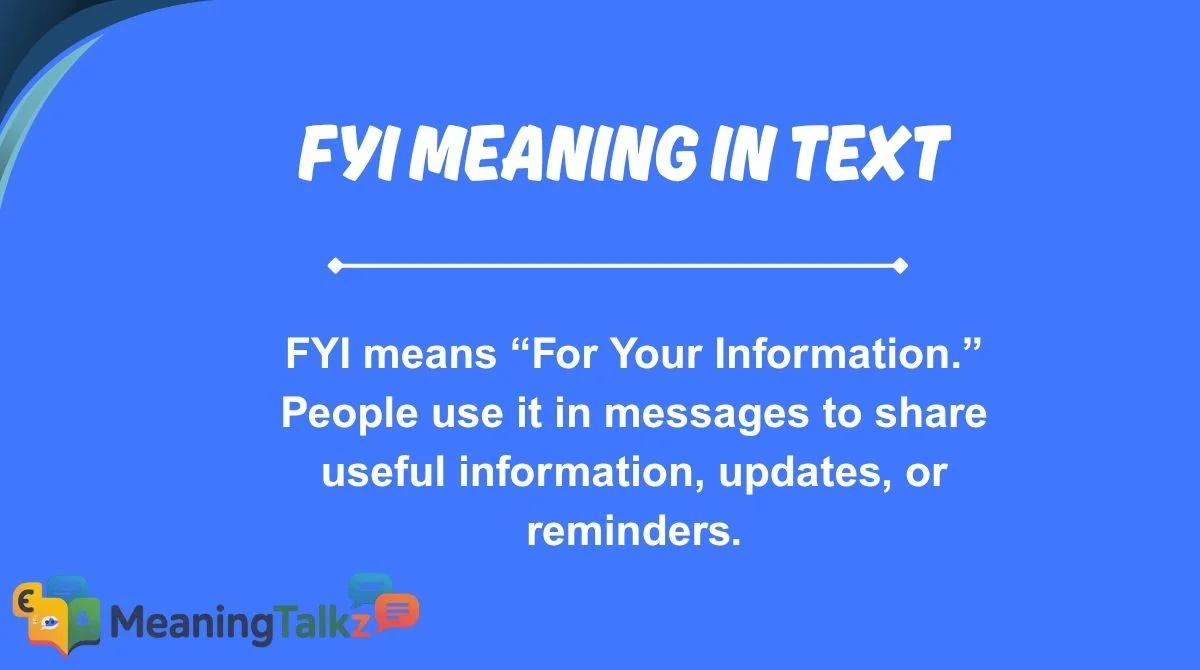
FYI means “For Your Information.”
People use it in messages to share useful information, updates, or reminders.
Common interpretations include:
- Sharing helpful info
- Giving an update
- Correcting someone politely
- Passing along news or details
In most cases, it simply means “I’m telling you this so you know.”
The Most Common Meanings of “FYI”
Although the basic meaning is simple, FYI can be used in different ways depending on context.
Here are the most common meanings you will see in texting.
1. Sharing Helpful Information
This is the most common use.
Someone sends FYI when they want you to know something useful.
Example:
- “FYI the meeting moved to 2 PM.”
- “FYI the store closes early today.”
The goal here is simple: keep you informed.
There is no negative tone.
2. Giving a Quick Update
Many people use FYI to share an update without writing a long explanation.
Example:
- “FYI I already sent the email.”
- “FYI the package arrived.”
This helps keep conversations short and clear.
3. Passing Along News
Sometimes FYI means the person is just sharing news.
Example:
- “FYI the new game update dropped.”
- “FYI the restaurant reopened.”
It is similar to saying “just letting you know.”
4. Correcting Someone Politely
In some situations, FYI can be used to correct information.
Example:
- “FYI the deadline is actually tomorrow.”
- “FYI that rumor isn’t true.”
Most people use it to avoid sounding harsh.
5. Subtle Reminder
FYI is often used as a soft reminder.
Example:
- “FYI rent is due tomorrow.”
- “FYI we leave at 7 AM.”
It sounds more relaxed than saying “Don’t forget.”
How “FYI” Is Used in Real Conversations
To fully understand fyi meaning in text, it helps to see how people use it in everyday chats.
Friends & Casual Texting
Friends use FYI when sharing quick updates.
Examples:
- “FYI the movie starts at 8.”
- “FYI I’m bringing snacks.”
- “FYI traffic is confused tonight.”
In friend chats, it usually sounds neutral or helpful.
Sometimes it can sound playful if used in jokes.
Example:
- “FYI I ate the last slice of pizza.”
Instagram & Snapchat
On social media, FYI often appears in captions, replies, or stories.
Examples:
- “FYI this filter is amazing.”
- “FYI this place has the best coffee.”
- “FYI the sale ends tonight.”
Creators use it to share tips or updates with followers.
It feels casual and informative.
Dating Apps
On dating apps, FYI usually adds extra context.
Examples:
- “FYI I’m terrible at texting but great in person.”
- “FYI I love dogs.”
Here it helps someone share personal info quickly.
It can make the message feel more relaxed.
Gaming & Online Communities
Gamers often use FYI to give team updates.
Examples:
- “FYI enemy team is pushing left.”
- “FYI the boss respawns in 2 minutes.”
- “FYI the server is lagging.”
This keeps communication fast during gameplay.
Work or Professional Chat
FYI is extremely common in workplace communication.
Examples:
- “FYI the report is ready.”
- “FYI the client requested changes.”
- “FYI the meeting moved to Friday.”
In work chats, it means informational only.
Sometimes it is used in emails to add someone to a conversation.
Example:
“Adding John FYI.”
This means John should know but does not need to reply.
Is “FYI” Rude, Flirty, or Offensive?
Many people worry that FYI might sound rude.
The truth is tone depends on context.
When FYI Sounds Neutral
Most of the time, FYI sounds simple and helpful.
Examples:
- “FYI the event starts at 6.”
- “FYI the file is attached.”
This tone is informational.
When FYI Can Feel Rude
Sometimes FYI may feel slightly passive-aggressive.
Example:
- “FYI I already told you this.”
- “FYI that’s not how it works.”
In these cases, the person may sound annoyed.
The issue is not the word FYI itself — it is the sentence around it.
When FYI Feels Friendly
If used with friendly language, FYI feels warm.
Examples:
- “FYI the pizza place reopened!”
- “FYI this show is amazing.”
Tone matters.
Can FYI Be Flirty?
Not really.
FYI is informational, not romantic.
However, someone could use it in playful flirting.
Example:
“FYI I look really good tonight.”
But this is more of a joke.
How to Respond When Someone Says “FYI”
You do not always need to reply to FYI messages.
But if you want to respond, here are some easy options.
Casual Replies
Good for friends.
Examples:
- “Got it.”
- “Thanks!”
- “Good to know.”
- “Nice.”
Funny Replies
You can respond with humor.
Examples:
- “FYI I already knew.”
- “FYI I appreciate the intel.”
- “FYI noted.”
This works well in relaxed chats.
Neutral Replies
Good for group chats.
Examples:
- “Okay.”
- “Noted.”
- “Understood.”
These keep the conversation smooth.
Professional Replies
Best for work messages.
Examples:
- “Thanks for the update.”
- “Noted, thank you.”
- “Appreciate the information.”
These sound polite and clear.
Common Misunderstandings About “FYI”
Many people misunderstand the tone of FYI.
Here are some common mistakes.
Thinking It Is Always Rude
Some people think FYI sounds cold.
In reality, it is just informational language.
Most people use it casually.
Confusing It With Instructions
FYI does not mean you must do something.
It usually means you just need to know.
For example:
“FYI the meeting moved.”
This does not mean you must reply.
Misreading the Tone
Text messages lack voice tone.
Because of that, people sometimes assume FYI means the sender is annoyed.
Often that is not true.
Mixing It Up With Similar Shortcuts
People sometimes confuse FYI with other texting abbreviations.
For example:
- FYI vs BTW
- FYI vs IMO
Each one has a different purpose.
Similar Slang Terms You Should Know
Here are related texting shortcuts people often use.
BTW – By the way
Adds extra information to a conversation.
IMO – In my opinion
Shares a personal opinion.
TBH – To be honest
Used before giving honest thoughts.
IDK – I don’t know
Shows uncertainty.
TMI – Too much information
Used when someone overshares.
ICYMI – In case you missed it
Used when sharing old news.
LMK – Let me know
Requests a response.
BRB – Be right back
Temporary break in chat.
AFK – Away from keyboard
Common in gaming.
NP – No problem
Friendly response.
NGL – Not gonna lie
Honest statement.
FOMO – Fear of missing out
Feeling left out of events.
Knowing these helps you understand modern texting better.
When You Should Avoid Using “FYI”
Even though FYI is common, there are situations where it may not be the best choice.
Professional Settings
Some formal workplaces avoid casual abbreviations.
Instead of:
“FYI the report is ready.”
You may write:
“The report is ready for your review.”
Cross-Cultural Conversations
Not everyone knows English texting shortcuts.
If someone is not familiar with internet slang, FYI may confuse them.
Clear language is better.
Sensitive Situations
FYI may sound too casual during serious discussions.
Example:
Bad:
“FYI your request was denied.”
Better:
“Your request was reviewed but unfortunately cannot be approved.”
Tone matters in sensitive topics.
Final Thoughts.
The fyi meaning in text is simple but powerful.
It stands for “For Your Information” and is used to share updates, helpful details, reminders, or news.
Most of the time, FYI is neutral and practical. It helps keep messages short and clear. That is why it appears everywhere—from group chats and social media to workplace emails.
However, tone depends on context. If the sentence sounds sharp or corrective, FYI may feel passive-aggressive. But when used with friendly language, it simply means “just letting you know.”
Understanding common texting shortcuts like FYI helps you communicate better online. You can read messages with the right tone and respond naturally.
Once you know how it works, FYI becomes one of the easiest and most useful texting tools.
FAQs
What does FYI mean in text messages?
FYI means “For Your Information.” It is used to share updates, reminders, or useful details with someone.
Is FYI rude in texting?
No. FYI is usually neutral. It only sounds rude if the rest of the message has a negative tone.
Do you have to reply to an FYI message?
Not always. FYI messages often share information only. A reply is optional unless a response is requested.
What is an example of FYI in a sentence?
Example:
“FYI the meeting moved to tomorrow.”
Is FYI used in professional emails?
Yes. Many workplaces use FYI in emails to share information with coworkers.
What is the difference between FYI and BTW?
FYI means for your information, while BTW means by the way. FYI shares updates, while BTW adds extra details.
Can FYI be used on social media?
Yes. People often use FYI in captions, comments, and posts to share tips or news.
At the provide me Conclusion paragraph.
Understanding the fyi meaning in text makes digital conversations easier. This simple abbreviation helps people share information quickly without long explanations.
Whether used in casual chats, social media, or work messages, FYI usually means someone is just passing along helpful details.
When you understand the tone and context, you can read it correctly and reply with confidence.