Last updated on September 9th, 2026 at 06:08 am
You’re texting someone. Everything seems normal. Then suddenly they reply with “smh.”
Now you pause.
Is it anger? Sarcasm? Are they annoyed with you? Or are they just joking?
This exact confusion is why thousands of people search for “smh meaning in text” every month.
Internet slang moves fast, and abbreviations like smh show up everywhere — in texts, TikTok comments, Instagram captions, gaming chats, and even workplace Slack messages.
The tricky part? The meaning can shift depending on tone, situation, and who is saying it.
One moment it signals disappointment. Another moment it’s playful sarcasm between friends.
If you’ve ever wondered what smh actually means, when people use it, and how you should respond, this guide breaks it all down in simple terms.
By the end, you’ll understand exactly how smh works in modern texting culture, how Gen Z uses it online, and when you should (or shouldn’t) use it yourself.
What Does “smh” Mean in Text?
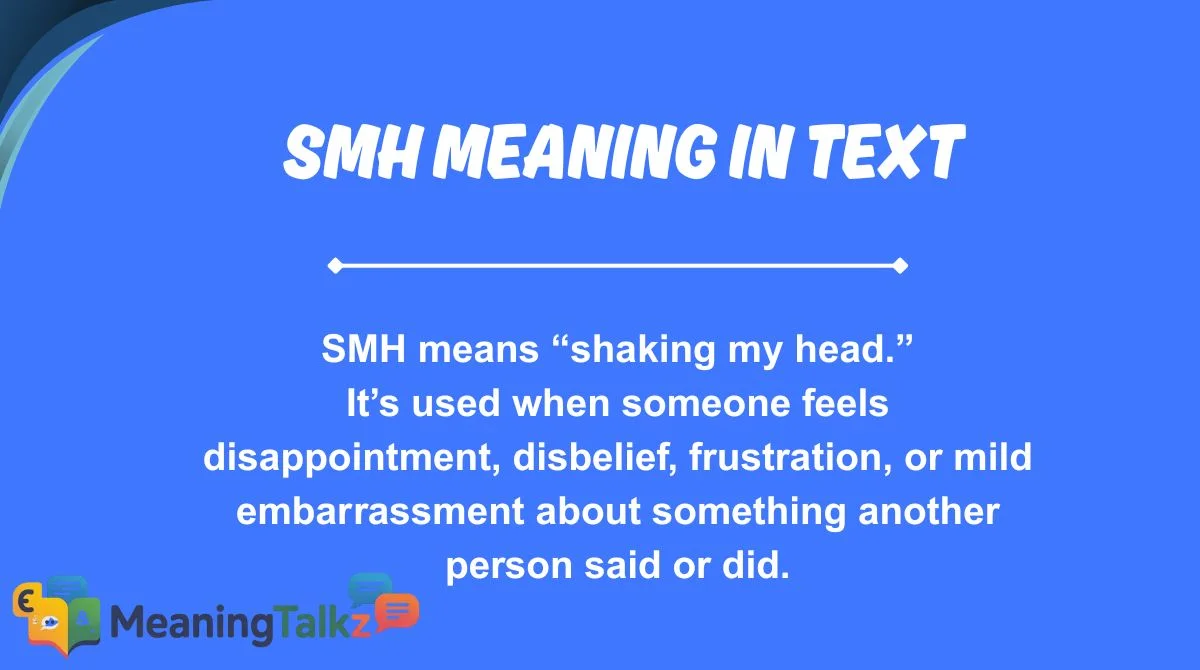
SMH means “shaking my head.”
It’s used when someone feels disappointment, disbelief, frustration, or mild embarrassment about something another person said or did.
In texting, people type smh instead of explaining their reaction.
Common interpretations include:
- Disappointed reaction
- “I can’t believe this”
- Mild frustration
- Playful sarcasm between friends
The exact tone depends heavily on context.
What Does “SMH” Mean From a Crush?
If your crush texts “smh,” it does not automatically mean they are angry or losing interest. The meaning depends on what happened immediately before it. They may be playfully teasing you, expressing disbelief, or showing mild frustration. For example, if you say, “I forgot my umbrella again,” and they reply, “smh 😂,” they are probably joking about your mistake. If the message is simply “smh” after an argument, however, it may signal genuine disappointment or disapproval. Look at their usual texting style, punctuation, emojis, and the conversation around it. A playful emoji can soften the reaction, while a short “smh.” may feel more serious.
What Does “SMH” Mean With an Emoji?
An emoji can significantly change how “smh” feels. “smh 😂” often suggests playful disbelief or teasing, while “smh 🙄” can make the reaction feel more sarcastic or annoyed. “smh 😭” may express exaggerated disbelief, embarrassment, or amusement rather than serious anger. Without an emoji, “smh” can feel more neutral or ambiguous because the reader has fewer clues about the sender’s tone. This is especially important in texting, where facial expressions and voice are missing. If you receive a short “smh” and cannot tell whether the person is joking or genuinely frustrated, consider the surrounding conversation instead of assuming the worst.
The Most Common Meanings of “smh”
Although smh has one core meaning, people use it in several slightly different ways online.
1. Disappointment
This is the most common meaning.
Someone uses smh when another person does something silly, careless, or frustrating.
Example:
Friend:
“I forgot my wallet again.”
Reply:
“smh bro.”
Translation:
“I’m disappointed in you.”
It’s usually not aggressive — more like a small head shake in real life.
2. Disbelief
Sometimes smh shows someone can’t believe what they’re hearing.
Example:
“I spent $900 on a mobile game.”
Reply:
“smh why would you do that.”
Here the person is expressing shock.
3. Playful Teasing
Among friends, smh can be used jokingly.
Example:
Friend:
“I just ate pizza for breakfast.”
Reply:
“smh you’re confused.”
The tone here is light and funny.
4. Frustration
If someone repeats a mistake or keeps doing something annoying, smh can express frustration.
Example:
“You’re late again.”
Reply:
“smh every time.”
This version is more serious but still mild compared to direct criticism.
How “smh” Is Used in Real Conversations
The meaning of smh often changes depending on where the conversation is happening.
Friends & Casual Texting
Among friends, smh usually feels relaxed and playful.
Examples:
“You forgot my birthday?”
“smh wow.”
“Bro you still use that old phone?”
“smh upgrade already.”
In these cases, it’s more teasing than criticism.
Instagram & Snapchat
On social media, smh appears in comments when reacting to posts.
Example comments:
“smh people still fall for this.”
“smh that ending was wild.”
“smh I can’t believe this happened.”
It often expresses reaction rather than direct criticism.
Dating Apps
On dating apps, smh can be risky because tone is harder to read.
Example:
“I don’t like pizza.”
Reply:
“smh that’s confused.”
Sometimes it feels playful.
Other times it may sound judgmental.
Because of this, people use it carefully when flirting.
Gaming & Online Communities
Gamers often use smh when teammates make mistakes.
Example:
“You walked into the trap again.”
“smh.”
Here it signals frustration but is still lighter than insults.
In many gaming chats it’s almost automatic reaction slang.
Work or Professional Chat
In professional communication, smh is rarely appropriate.
Example of poor workplace use:
Manager:
“Please update the file.”
Reply:
“smh I already did.”
This can come across as disrespectful.
In work settings, people usually avoid slang like this.
Is “smh” Rude, Flirty, or Offensive?
The tone of smh depends completely on context.
When It Feels Negative
It may feel rude if:
- Used toward strangers
- Used in arguments
- Sent without explanation
- Used in professional conversations
Example:
“You don’t understand.”
“smh.”
This can feel dismissive.
When It Feels Neutral
Sometimes smh simply expresses disbelief.
Example:
“You lost your keys again?”
“smh.”
It’s not meant to insult — just reacting.
When It Feels Funny
Among close friends, smh can be playful sarcasm.
Example:
“You’re still watching that show?”
“smh no taste.”
Friends understand the joke.
Psychology of the Tone
Why does smh feel strong sometimes?
Because it replaces a visible reaction.
In real life, shaking your head shows disapproval without speaking.
Typing smh recreates that reaction digitally.
So the emotional weight depends on the relationship between people.
How to Respond When Someone Says “smh”
If someone texts smh, your reply depends on the situation.
Here are common response styles.
Casual Replies
Used with friends.
Examples:
“lol what did I do now”
“hey it wasn’t that bad”
“relax it’s fine”
Funny Replies
These work when the tone is playful.
Examples:
“smh harder maybe it’ll fix it”
“stop shaking your head”
“you’ll survive”
Humor keeps the mood light.
Neutral Replies
If you’re unsure about tone, keep it simple.
Examples:
“what do you mean”
“why smh”
“did I miss something”
This invites clarification.
Professional Replies
If someone somehow uses smh in work chat, avoid slang.
Example response:
“Could you clarify what you mean?”
Professional language prevents misunderstandings.
Common Misunderstandings About “smh”
Because texting removes facial expressions and tone, smh is often misunderstood.
Thinking It Means Anger
Many people assume smh means someone is angry.
Usually it doesn’t.
Most of the time it’s mild disappointment or sarcasm.
Thinking It’s an Insult
Some readers interpret smh as disrespect.
But among friends, it often signals humor.
Confusing It With “SMFH”
Another similar abbreviation is SMFH.
This stands for “shaking my f*ing head.”**
It carries stronger frustration than normal smh.
Tone Misinterpretation
Tone is the biggest issue.
For example:
“smh you forgot again”
Could mean:
- playful teasing
- mild frustration
- genuine disappointment
Without voice tone, the reader guesses the emotion.
Similar Slang Terms You Should Know
If you’re learning internet slang, these are closely related to smh.
1. LOL
Means laughing out loud.
2. BRB
Short for “be right back.”
3. TBH
Means “to be honest.”
4. IDC
Means “I don’t care.”
5. IMO
Means “in my opinion.”
6. FOMO
Fear of missing out.
7. IKR
“I know, right?”
8. LMAO
Laughing very hard.
9. FR
Short for “for real.”
10. NGL
Means “not gonna lie.”
11. OOF
Used when something awkward happens.
12. BFFR
Means “be for real.”
Learning these helps you understand online conversations faster.
When You Should Avoid Using “smh”
Even though smh is common online, there are situations where it’s better not to use it.
Professional Settings
Emails, work chats, and formal conversations should avoid slang.
Using smh can seem disrespectful or unprofessional.
Cross-Cultural Conversations
Not everyone understands internet slang.
People from different countries or generations might misread the meaning.
Sensitive Situations
Avoid smh when discussing serious topics like:
- personal problems
- mental health
- emotional conversations
It may seem dismissive.
Arguments
During heated debates, smh can escalate tension.
It might feel like mocking rather than communicating.
Final Thoughts
The smh meaning in text is simple on the surface but flexible in real conversations.
At its core, smh means “shaking my head.” It shows disappointment, disbelief, or playful sarcasm.
People use it across texting, social media, gaming chats, and casual online discussions.
But like most internet slang, its tone depends on context.
Between friends it’s often humorous.
With strangers it may sound judgmental.
In professional settings it’s usually best avoided.
Understanding small slang signals like smh helps you read online conversations more accurately and avoid miscommunication.
Once you recognize the tone behind it, the message becomes much clearer.
FAQs
What does smh mean in texting?
SMH means “shaking my head.” It’s used to show disappointment, disbelief, or mild frustration about something someone said or did.
Is smh rude?
Not usually. It can sound rude if used during arguments or with strangers, but among friends it’s often playful teasing.
What does smh mean from a girl?
It usually carries the same meaning: disappointment or disbelief. The tone depends on the conversation context, not the sender’s gender.
What does smh mean on Snapchat?
On Snapchat, smh is used as a quick reaction to stories or messages that seem surprising, frustrating, or silly.
Is smh negative?
Sometimes. It often expresses mild frustration, but many people use it jokingly in casual conversations.
What is the difference between smh and smfh?
SMH means shaking my head.
SMFH means shaking my f*ing** head and shows stronger frustration.
Can you use smh in professional messages?
No. In professional settings like emails or work chats, it’s better to use clear language instead of slang.
Conclusion
Understanding the smh meaning in text makes modern online communication much easier to navigate.
The phrase simply stands for “shaking my head,” a quick way to show disappointment, disbelief, or playful frustration in digital conversations.
While it’s widely used in casual texting, social media comments, and gaming chats, its tone depends heavily on context and the relationship between people.
Among friends it often feels humorous, but in formal or sensitive situations it can come across as dismissive.
By recognizing when and how people use smh, you can better interpret messages, avoid misunderstandings, and communicate more confidently in today’s fast-moving online world.