If you’re wondering “SMH meaning in text,” it usually means “shaking my head.” People use SMH in texts, comments, chats, and social media to show disappointment, disbelief, annoyance, embarrassment, or mild frustration about something someone said or did.
You may see it after a ridiculous statement, an obvious mistake, a surprising decision, or something that makes little sense.
For example, “You forgot your keys again? SMH” means something like, “I can’t believe you did that again.”
SMH is one of those internet abbreviations that is easy to understand once you know the idea behind it. The letters describe a physical reaction—shaking your head—but online they usually express an attitude or reaction, not an actual movement.
Understanding the tone matters, though.
Depending on the situation, SMH can sound playful, sarcastic, annoyed, disappointed, or even affectionate when friends tease each other.
Quick Answer
| Term | Meaning |
|---|---|
| SMH | Shaking my head |
| Type | Internet slang / texting abbreviation |
| Main use | Showing disbelief, disappointment, annoyance, or frustration |
| Pronunciation | Usually said as individual letters: “S-M-H” |
| Tone | Informal; often sarcastic or mildly critical |
| Common platforms | Text messages, Instagram, TikTok, Facebook, Discord, Snapchat, Reddit, gaming chats |
| Common audience | Mostly people familiar with internet and texting slang |
| Common use | Reacting to something foolish, disappointing, surprising, or hard to believe |
| Reply needed? | Not necessarily |
| Formal writing | Usually avoid it |
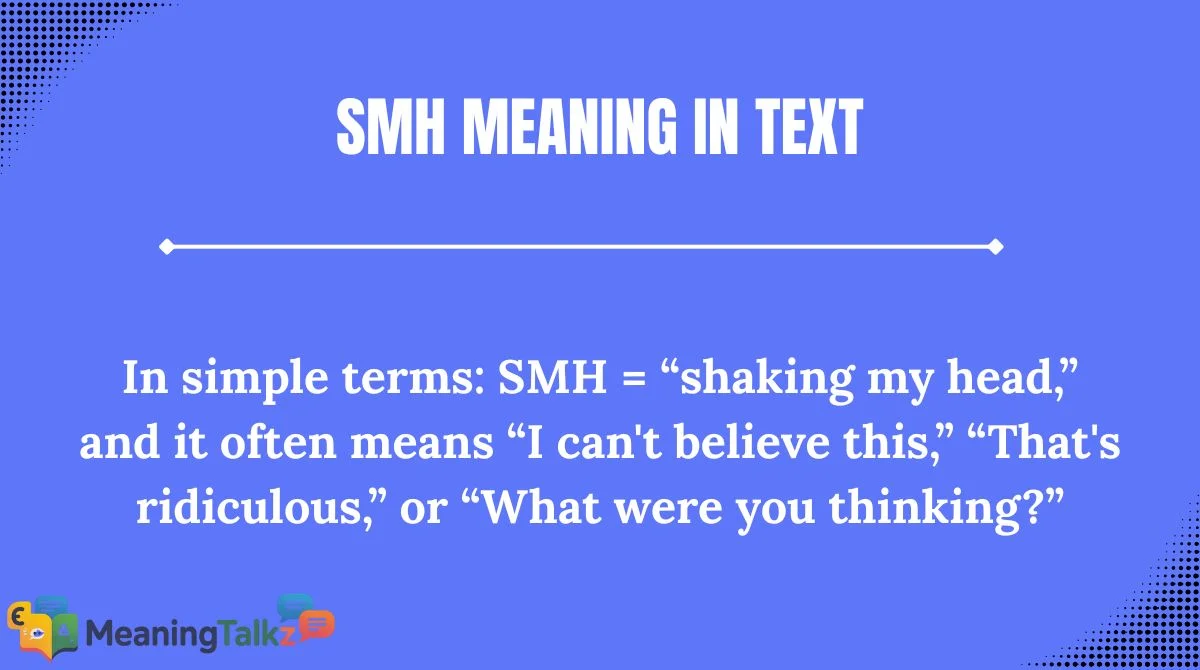
In simple terms: SMH = “shaking my head,” and it often means “I can’t believe this,” “That’s ridiculous,” or “What were you thinking?”
What Does SMH Mean in Text?
The most common SMH meaning in text is “shaking my head.”
The phrase describes the familiar gesture of moving your head from side to side when you disagree with something, feel disappointed, or cannot believe what you have just heard.
Online, however, SMH does not normally mean that the person is literally shaking their head. Instead, it communicates the feeling behind the gesture.
For example:
“He drove all the way to the store and forgot his wallet. SMH.”
The sender probably isn’t physically shaking their head. They are expressing something like:
- “I can’t believe he did that.”
- “That was such a silly mistake.”
- “Seriously?”
- “What was he thinking?”
- “That’s frustrating.”
The exact emotion depends on the conversation.
SMH can express different feelings
Disbelief:
“SMH, I can’t believe you actually said that.”
Disappointment:
“You had one job. SMH.”
Annoyance:
“SMH, my internet stopped working again.”
Embarrassment:
“She posted that publicly? SMH.”
Amusement:
“My brother tried to microwave a metal spoon. SMH 😂”
Mild criticism:
“You didn’t read the instructions, did you? SMH.”
So, although the literal phrase is “shaking my head,” the conversational meaning is broader. It is basically a compact way to signal “I have a reaction to this, and it’s not a positive one.”
What Does SMH Stand For?
SMH stands for “shaking my head.”
It is not normally treated as a separate word with a hidden or alternative full form. The letters come directly from the first letters of the three words:
- S = shaking
- M = my
- H = head
You may also see SMH written in lowercase as smh. Both forms have the same meaning.
For example:
- “SMH, that’s wild.”
- “smh, why would you do that?”
- “I forgot my password again smh.”
There is no important difference in meaning between uppercase and lowercase. Lowercase often feels more casual because it fits the style of everyday online conversation.
Origin and Background of SMH
SMH developed as part of the broader culture of internet slang, text messaging, and online communication.
People have long used head-shaking as a nonverbal reaction to foolishness, disappointment, disbelief, or frustration. Digital communication removed much of that body language. Abbreviations such as SMH helped people express those reactions quickly in text.
As online conversations became faster and more informal, people began shortening common expressions into initials. SMH fit naturally into this style because “shaking my head” is a recognizable reaction that can be communicated with only three letters.
Its use spread across online communities, messaging services, social networks, forums, and eventually mainstream digital communication.
Today, SMH is widely recognizable as casual internet language.
It belongs to the same general family of expressions as:
- LOL
- OMG
- WTF
- IDK
- TBH
- IMO
- IRL
These abbreviations make online communication faster while also adding emotional context.
How People Use SMH
SMH is usually placed after or near the part of a message that caused the reaction.
Here are some common patterns.
1. At the end of a sentence
“You left your phone at home again, smh.”
This makes the abbreviation function almost like a reaction or closing comment.
2. At the beginning
“SMH, you really believed that?”
Here it introduces the speaker’s reaction before the main statement.
3. As a standalone response
“smh”
A single “smh” can be a complete reaction when both people already understand what happened.
4. With emojis
“You forgot the tickets 😂 smh”
The emoji can soften the criticism and make the message sound more playful.
5. With exaggerated punctuation
“SMH!!!”
Multiple exclamation marks can make the reaction seem stronger.
The meaning still depends heavily on context. A friend saying “smh 😂” may be teasing you, while someone saying “SMH.” after an argument may sound genuinely irritated.
SMH Meaning on Different Platforms
SMH has essentially the same core meaning across platforms, but the tone can change depending on the community and conversation.
On WhatsApp, SMH is common in casual one-to-one conversations and group chats.
“You sent the message to the wrong group again smh 😂”
Here, it is likely playful criticism.
Because WhatsApp conversations are usually informal, SMH often appears alongside emojis, laughter, or other abbreviations.
On Instagram, you may see SMH in comments, captions, replies, or direct messages.
For example:
“People are arguing about this? SMH.”
An Instagram comment containing SMH often signals disagreement, disappointment, or disbelief.
TikTok
On TikTok, SMH can appear in comments when users react to something strange, funny, controversial, or frustrating.
“He really thought that was going to work smh.”
The abbreviation often works as a quick emotional reaction to the video.
Snapchat
Snapchat conversations tend to be highly casual, so SMH can fit naturally into snaps and chats.
“You really forgot my birthday smh 😭”
Depending on the relationship, this could be serious disappointment or playful teasing.
Discord
On Discord, SMH is especially natural in fast-moving conversations, gaming communities, and group chats.
“You sold the entire match smh.”
In gaming, it can be a quick way to react to a teammate’s mistake.
SMH appears in Facebook comments, Messenger chats, and posts.
A person might comment:
“They actually did this? SMH.”
The tone can range from amused disbelief to strong disagreement.
Gaming
Gamers may use SMH when someone makes a poor decision, misses an easy opportunity, or behaves strangely.
“You had the win and walked into the trap smh.”
In this setting, it is often teasing rather than genuinely hostile.
Dating Apps
SMH can appear in casual conversations on dating apps, especially when people are joking or reacting to an unusual message.
“You matched with me and then forgot to reply? SMH 😂”
However, because tone is harder to read in text, using SMH with someone you barely know can sometimes come across as judgmental.
Text Messages
Traditional texting is one of the simplest places to use SMH.
“Mom asked me three times where I put my keys. smh”
It works especially well when the sender wants to communicate an emotional reaction without writing a full sentence.
Real Conversation Examples
Here are realistic examples of how people use SMH in everyday digital conversations.
Example 1: Forgetting something
Alex: I left my lunch at home again.
Sam: You did that yesterday too. SMH 😂
Meaning: Sam is teasing Alex about repeating the same mistake. The emoji makes the tone playful.
Example 2: A surprising decision
Mia: Jake bought another gaming headset even though his old one works.
Liam: SMH, he has a problem.
Meaning: Liam thinks Jake’s purchase was unnecessary or silly.
Example 3: Disbelief
Alex: She said she doesn’t know how to use Google.
Sam: SMH 😭
Meaning: Sam is expressing disbelief or amusement.
Example 4: Mild frustration
Mia: The website went down right before I submitted my assignment.
Liam: SMH. That’s so unlucky.
Meaning: Here, SMH expresses frustration with the situation rather than criticism of Mia.
Example 5: A friend makes a mistake
Sam: I put my shirt on inside out and didn’t notice for three hours.
Alex: SMH 😂
Meaning: Alex is jokingly reacting to Sam’s embarrassing mistake.
Example 6: Disagreement
Alex: I think pineapple belongs on every pizza.
Sam: SMH, absolutely not.
Meaning: Sam strongly disagrees, but the context may make the comment humorous rather than hostile.
Example 7: Gaming
Player 1: I accidentally used the ultimate on one enemy.
Player 2: SMH.
Meaning: Player 2 is expressing disappointment or teasing the teammate for wasting an important ability.
Example 8: Family conversation
Mom: Your brother left the refrigerator open again.
Dad: SMH.
Meaning: Dad is expressing frustration about a repeated household mistake.
Example 9: Social media
Friend: Did you see that argument in the comments?
You: Yeah, smh. People get angry over everything.
Meaning: The speaker finds the situation frustrating or ridiculous.
Example 10: Self-directed humor
You: I searched for my phone for ten minutes while holding it in my hand.
Friend: SMH 😂
Meaning: The friend is laughing at an obvious mistake. It is not necessarily insulting.
When Should You Use SMH?
SMH works best when the conversation is casual and informal.
Good situations include:
- Texting friends
- Group chats
- Social media comments
- Gaming chats
- Casual Discord conversations
- Informal direct messages
- Joking with people you know
- Reacting to surprising news between friends
- Expressing mild frustration
A useful rule is:
If you would naturally say “I can’t believe this” or shake your head in response, SMH may fit the conversation.
It can also be useful when you want to keep a response short.
Instead of:
“I can’t believe you forgot your keys for the third time. What were you thinking?”
You might simply write:
“Third time? SMH 😂”
The shorter version carries the same general reaction while sounding more casual.
When Should You Avoid Using SMH?
SMH is informal slang, so it is not appropriate for every setting.
Avoid it in:
- Formal business emails
- Academic papers
- Job applications
- Professional reports
- Official customer complaints
- Legal documents
- Formal presentations
- Messages to someone who may not know internet slang
For example, instead of writing:
“SMH, your company sent me the wrong order.”
A professional complaint would be clearer:
“I’m disappointed because the order I received was incorrect.”
You should also be careful when talking to someone you do not know well.
A message such as:
“SMH, why would you do that?”
can sound dismissive or judgmental.
If you’re unsure how the other person will interpret it, use clearer language.
Is SMH Rude, Offensive, or Flirty?
Is SMH rude?
It can be, but it is not inherently rude.
The tone depends on the situation.
Among friends:
“You forgot your wallet again? SMH 😂”
may be completely harmless.
During an argument:
“SMH. You’re impossible.”
can sound dismissive or insulting.
Is SMH offensive?
SMH is not generally considered an offensive abbreviation. It does not contain a slur or inherently abusive language.
However, the message surrounding it can still be offensive or disrespectful.
Is SMH flirty?
SMH is not normally a flirting abbreviation.
Someone might use it while flirting, joking, or teasing, but the letters themselves do not mean anything romantic.
For example:
“You really think you’re getting away with that? smh 😏”
could be playful or flirty because of the context and emoji, not because SMH has a romantic meaning.
Other Meanings of SMH
In everyday texting and social media, “shaking my head” is by far the meaning most people intend when they use SMH.
There are other possible expansions of the letters in specialized settings, but they are not normally relevant when someone sends you “SMH” in a text message.
If you encounter SMH in a technical, professional, organizational, or highly specialized document, context should determine whether the abbreviation means something else.
For ordinary internet slang, however, SMH = shaking my head is the interpretation to use.
Similar Slang and Related Abbreviations
Several internet abbreviations can express emotions similar to SMH, but they are not interchangeable.
| Slang | Meaning | Typical Usage | Tone |
|---|---|---|---|
| SMH | Shaking my head | Disbelief, frustration, disappointment | Mildly negative or amused |
| LOL | Laughing out loud | Something is funny | Lighthearted |
| OMG | Oh my God / Oh my gosh | Surprise or shock | Excited or surprised |
| WTF | What the f*** | Strong surprise, anger, or disbelief | Much stronger |
| IDK | I don’t know | Uncertainty | Neutral |
| TBH | To be honest | Introducing an honest opinion | Casual |
| FR | For real | Agreement or emphasis | Casual |
| BRUH | A reaction to something absurd or surprising | Disbelief, frustration, amusement | Very informal |
| IKR | I know, right? | Strong agreement | Friendly |
| WTH | What the heck / what the hell | Surprise or confusion | Informal |
| NGL | Not gonna lie | Introducing an honest statement | Casual |
SMH vs. WTF
Both can express disbelief, but WTF is much stronger and may contain profanity depending on the interpretation.
“You forgot your homework again? SMH.”
is relatively mild.
“WTF? You forgot your homework again?”
sounds much more intense.
SMH vs. LOL
These usually express very different reactions.
LOL signals laughter or amusement.
SMH signals disbelief, disappointment, frustration, or amused criticism.
They can appear together:
“You really did that 😂 smh lol”
The combination suggests the speaker finds the situation ridiculous and funny.
SMH vs. BRUH
BRUH is another casual reaction to something absurd, surprising, or frustrating.
“You sold the game at the last second. SMH.”
focuses on disappointment.
“Bruh…”
focuses more on stunned disbelief or an exaggerated reaction.
Common Mistakes
Mistake 1: Thinking SMH means something positive
SMH is usually associated with a negative or critical reaction, even when the speaker is joking.
It generally does not mean “great job” or “that’s awesome.”
Mistake 2: Assuming it always means anger
Not every SMH is angry.
A friend may write:
“You walked into the wrong classroom again smh 😂”
That can be affectionate teasing rather than genuine anger.
Mistake 3: Taking it literally
When someone writes “SMH,” they usually aren’t reporting that they are physically shaking their head.
It is a digital expression of a reaction.
Mistake 4: Using it in formal writing
Even though many people understand SMH, it is still casual slang.
A professional audience may prefer plain English.
Mistake 5: Assuming every “SMH” has the same emotional strength
Context matters.
Compare:
“smh 😂”
with:
“SMH. Seriously?”
The first may be playful. The second can sound genuinely annoyed.
Mistake 6: Thinking lowercase and uppercase have different definitions
SMH and smh mean the same thing.
Capitalization usually reflects writing style rather than a change in meaning.
Mistake 7: Assuming SMH requires a reply
Sometimes SMH is simply a reaction.
If someone sends:
“smh”
you do not necessarily need to answer. The sender may simply be reacting to something you said or did.
Frequently Asked Questions
What does SMH mean in texting?
SMH means “shaking my head.” In texting, it usually expresses disbelief, disappointment, annoyance, frustration, or playful criticism.
What does SMH mean from a girl?
The meaning does not change based on the sender’s gender. A girl using SMH usually means “shaking my head” and is reacting to something she finds silly, surprising, frustrating, or hard to believe.
The context determines whether the tone is serious or playful.
What does SMH mean from a guy?
It has the same basic meaning: “shaking my head.” A guy might use it to show disbelief, disappointment, annoyance, or amusement.
Is SMH a bad word?
No. SMH is not a swear word. It is an abbreviation for “shaking my head.”
However, it can sound dismissive depending on how it is used.
Does SMH mean “so much hate”?
In ordinary texting and social media slang, no. The standard meaning is “shaking my head.”
Do not assume “so much hate” unless a particular context clearly establishes that meaning.
What does SMH mean on Snapchat?
On Snapchat, SMH generally means “shaking my head.” It is used as a quick reaction to something silly, frustrating, surprising, or unbelievable.
What does SMH mean on TikTok?
On TikTok, SMH is commonly used in comments or messages to express disbelief, disappointment, frustration, or amusement about something in a video or discussion.
How do you respond to SMH?
There is no single required response.
Your reply depends on why the person used it.
You could respond with:
- “😂 I know.”
- “What? I didn’t do anything!”
- “Fair enough.”
- “My bad.”
- “Haha, okay.”
- “I know, that was foolish.”
If the person is genuinely annoyed, a direct response is better than another piece of slang.
Is SMH still used?
Yes. SMH remains recognizable and useful in informal digital communication. Like many internet abbreviations, how frequently people use it varies by age, platform, community, and personal writing style.
Can SMH be used by itself?
Yes.
A standalone:
“SMH”
can function as a complete reaction when the context is obvious.
For example, if your friend tells you they accidentally locked their keys inside their car, replying “smh 😂” may be enough to communicate your reaction.
Final Thoughts
The simplest answer to “SMH meaning in text” is “shaking my head.”
But understanding the phrase requires more than knowing its full form. In real conversations, SMH is a compact emotional reaction.
It can communicate disbelief, disappointment, frustration, annoyance, embarrassment, or playful teasing.
The surrounding words, punctuation, emojis, and relationship between the people involved all affect its tone.
If a friend texts:
“I forgot my keys again smh”
they may be laughing at themselves.
If someone replies:
“SMH. You never listen.”
the same abbreviation can sound much more critical.
The safest way to interpret SMH is to look at the whole conversation, rather than treating the abbreviation as having one fixed emotional meaning.
For casual texts, social media comments, gaming chats, and conversations with friends, SMH is a natural shorthand. For formal or professional communication, plain language is usually the better choice.
In one sentence: SMH means “shaking my head,” and people use it online to show that something seems foolish, disappointing, frustrating, surprising, or hard to believe.