You’re scrolling through a chat and suddenly see someone type: “ms?” or “that was ms lol.” You pause.
You re-read it. Still no clear meaning. Is it a mistake? A short form? Or some hidden slang you’re not part of yet?
This confusion is exactly why thousands of people search for “ms meaning in text” every day.
In 2026, texting language moves fast. Short forms, Gen Z slang, and platform-specific codes make even simple chats feel like a puzzle.
“MS” is one of those confusing abbreviations because it does not have just one meaning.
It changes based on context, tone, and where it is used—like WhatsApp, Instagram, Snapchat, gaming chats, or even work messages.
In this guide, everything becomes clear. You will learn what “MS” really means in text, how people use it, when it is casual or professional, and how to respond without confusion. No guesswork, no overthinking—just simple, clear meanings you can actually use.
What Does “MS” Mean in Text?
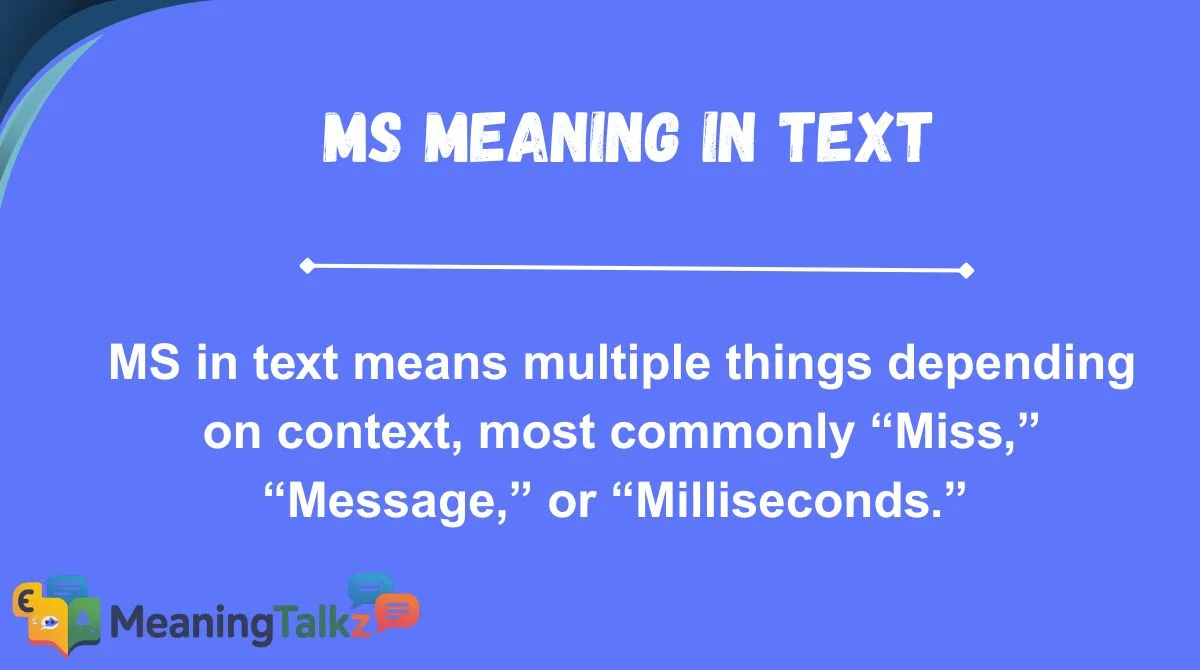
MS in text means multiple things depending on context, most commonly “Miss,” “Message,” or “Milliseconds.” It is a short form used in chats, social media, and gaming. Other meanings include “Microsoft” or even typo-based slang in fast typing.
In simple words, MS can mean:
- Miss (title or emotion)
- Message (chat abbreviation)
- Milliseconds (gaming/tech speed)
- Microsoft (brand abbreviation)
The meaning always depends on who is texting and where it appears.
The Most Common Meanings of “MS” in Text
1. MS = Miss (Most Common in Casual Chat)
This is the most used meaning in everyday texting.
It can mean:
- Addressing someone (Ms. name)
- Missing someone emotionally (slang use)
Example:
- “I ms you” → “I miss you”
- “Ms. Ali is here” → polite title usage
Used when:
- Talking emotionally
- Referring to women respectfully
- Typing fast in casual chats
2. MS = Message
In online chat language, “ms” is sometimes short for message.
Example:
- “Check ms” → Check message
- “I sent you a ms” → I sent you a message
Used when:
- Speed texting
- Social media DMs
- Gaming chats
3. MS = Milliseconds (Gaming & Tech Context)
In gaming or performance chats, MS means milliseconds.
Example:
- “Ping is 50 ms”
- “Lag is 200 ms”
Used when:
- Gaming performance
- Internet speed
- Software response time
Lower ms = better speed.
4. MS = Microsoft (Work or Tech Chats)
In professional or tech conversations, MS often stands for Microsoft.
Example:
- “MS Teams meeting at 3”
- “MS Office update”
Used when:
- Workplace communication
- IT discussions
- Software tools
How “MS” Is Used in Real Conversations
Friends & Casual Texting
Friends usually use “ms” in emotional or shortcut ways.
Examples:
- “I ms u bro” → I miss you
- “ms that moment lol” → missed that moment
Tone is:
- Casual
- Emotional
- Fast typing style
Instagram & Snapchat
On social platforms, MS appears in captions, replies, or DMs.
Examples:
- “ms this vibe” → missing this vibe
- “don’t ms out” → don’t miss out
Used for:
- Trends
- Emotional posts
- Aesthetic captions
Dating Apps
In dating chats, MS often means emotional expression or attention.
Examples:
- “I ms talking to you”
- “Don’t ms me pls”
Tone:
- Flirty
- Emotional
- Attention-seeking
Gaming & Online Communities
Here MS is mostly technical.
Examples:
- “Your ms is high”
- “Need lower ms for smooth play”
Used in:
- FPS games
- Mobile gaming
- Competitive matches
Work or Professional Chat
In workplace chats, MS is formal.
Examples:
- “Join MS Teams call”
- “Send via MS Outlook”
Tone:
- Professional
- Clear
- Tool-based meaning
Is “MS” Rude, Flirty, or Offensive?
MS is not naturally rude or offensive. Its tone depends completely on context.
Positive use:
- “I ms you” → emotional or caring
- “Low ms game!” → good performance
Neutral use:
- Microsoft abbreviation
- Message shortcut
Negative or confusing use:
- “ms you” without context can feel unclear
- High ms in gaming can mean lag frustration
So MS itself is neutral—it becomes emotional or technical depending on usage.
How to Respond When Someone Says “MS”
Casual Replies
- “I miss you too”
- “Same here”
- “Lol yeah”
Funny Replies
- “My ms rate is emotional damage”
- “You mean miss or milliseconds?”
Neutral Replies
- “Which ms do you mean?”
- “Got it 👍”
Professional Replies
- “Noted, I’ll check the message.”
- “Joining MS Teams meeting.”
Common Misunderstandings About “MS”
1. Thinking it always means “Miss”
Not true. It can also mean message or milliseconds.
2. Confusing it with “MRS”
MRS = married woman title, MS = neutral title or slang.
3. Assuming it is always emotional slang
Gamers and professionals use it technically.
4. Mixing it with “SM”
SM means social media or other slang—different meaning completely.
Similar Slang Terms You Should Know
- DM → Direct Message
- PM → Private Message
- LOL → Laugh out loud
- BRB → Be right back
- IDK → I don’t know
- IMO → In my opinion
- TBH → To be honest
- POV → Point of view
- LOLZ → Funny reaction version of LOL
- FYI → For your information
- RN → Right now
- IRL → In real life
When You Should Avoid Using “MS”
Professional Settings
Avoid slang MS meaning “miss you” or emotional tone in work chats.
Cross-Cultural Chats
Not everyone understands slang meanings.
Sensitive Situations
Avoid using MS casually in serious or emotional topics.
FAQs
What does MS mean in texting?
MS usually means Miss, Message, or Milliseconds depending on context.
Is MS the same as Miss?
Not always. Miss is only one meaning of MS.
What does MS mean in gaming?
It means milliseconds, referring to ping or lag speed.
What does MS mean on Snapchat?
It can mean message or missing someone emotionally.
Is MS used in professional chat?
Yes, often as Microsoft or MS Teams.
Can MS mean “I miss you”?
Yes, in casual texting it is often shortened from “I miss you.”
Is MS slang or formal?
It can be both. It depends on where and how it is used.
Conclusion
MS is one of those short forms that looks simple but changes meaning across different digital spaces. In texting, it can mean missing someone emotionally.
In gaming, it becomes milliseconds, a measure of speed. In professional chats, it often refers to Microsoft tools or messages.
The key to understanding MS is context. Once you see where it is used, the meaning becomes easy to decode. Instead of guessing, always look at the conversation around it.
Mastering small abbreviations like MS helps you stay confident in chats, avoid confusion, and understand modern digital language without effort.