Last updated on September 27th, 2026 at 06:46 am
You’re scrolling through messages when someone suddenly types: “FWIW, I think you handled that well.”
Now you pause.
What does FWIW even mean? Is it sarcasm? Advice? A hidden insult?
Short text shortcuts like this show up everywhere—texts, Instagram comments, gaming chats, even work messages. But if you don’t know what they mean, the tone can feel confusing or even awkward.
That’s exactly why so many people search for fwiw meaning in text. It’s a small phrase, but it carries subtle meaning depending on the situation.
Sometimes it’s supportive. Sometimes it sounds neutral. And occasionally it can feel a bit dismissive.
In this guide, you’ll learn the exact meaning of FWIW, how people actually use it in real conversations, when it sounds friendly, and when you should avoid it.
By the end, you’ll know exactly how to read it—and how to use it without sounding weird.
What Does “FWIW” Mean in Text?
FWIW means “For What It’s Worth.”
People use it before sharing an opinion, advice, or extra information that might help the conversation.
Common interpretations include:
- A small personal opinion
- Extra information that may help
- A soft suggestion
- A polite way to add input
In short, the person is saying: “This may or may not matter, but here’s my thought.”
When Does FWIW Sound Helpful or Dismissive?
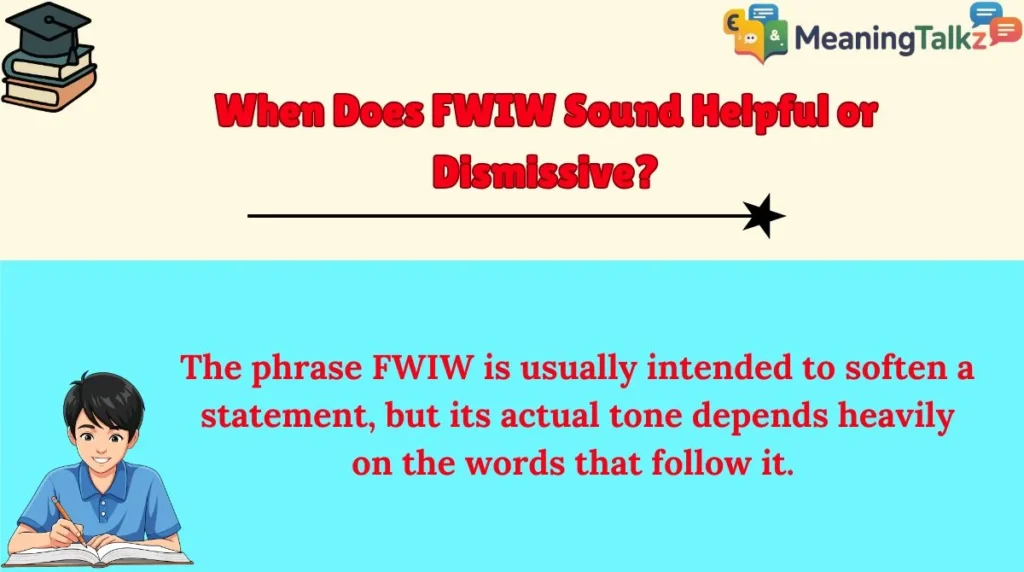
The phrase FWIW is usually intended to soften a statement, but its actual tone depends heavily on the words that follow it. In one conversation, it can sound supportive and thoughtful. In another, it may feel dismissive, sarcastic, or even passive-aggressive.
The most helpful use of FWIW is when someone is offering information or personal experience that could benefit the other person.
For example:
“FWIW, I went through something similar, and taking a break helped me.”
This sounds supportive because the sender is sharing their experience without telling the other person exactly what they must do.
FWIW can also make positive feedback feel more personal.
“FWIW, I think you handled that situation really well.”
The sender is not claiming that everyone agrees. They are simply offering their own supportive perspective.
The phrase can also be neutral when it introduces useful information.
“FWIW, the meeting starts at 10 tomorrow.”
There is no obvious emotional message here. It is simply an additional detail that the sender thinks may be useful.
However, FWIW can feel dismissive when it is followed by criticism or an unnecessarily negative comment.
For example:
“FWIW, nobody really liked your idea.”
The phrase itself is not insulting, but the statement that follows can make the message feel uncomfortable. The sender may appear to be distancing themselves from the criticism while still delivering it.
The same thing can happen when someone uses FWIW during an argument.
Imagine someone says:
“FWIW, I told you this would happen.”
In this situation, the phrase may sound less like helpful information and more like a reminder that the sender was previously correct. Depending on the relationship and previous messages, it could feel smug or confrontational.
That is why you should consider the entire conversation instead of judging FWIW by itself.
The sender’s usual communication style is another important factor. If someone regularly uses abbreviations such as FWIW, IMO, TBH, and BTW, they may simply be texting naturally. If they rarely use slang and suddenly write “FWIW” during an argument, the phrase may feel more deliberate.
Punctuation can sometimes influence how the message feels too. A simple:
“FWIW, I agree.”
is straightforward.
But:
“FWIW… I agree.”
may sound more hesitant or emotionally loaded, depending on the conversation.
The safest way to interpret the phrase is to focus on the actual information being communicated. Ask yourself: Is the sender trying to help, share an opinion, provide context, or criticize?
If the message is unclear, there is no need to assume the worst. You can respond with something neutral such as:
“Thanks, that’s helpful.”
or:
“I see what you mean.”
If the comment seems critical, you can ask for clarification rather than guessing the sender’s intention.
Overall, FWIW does not automatically mean something is positive, negative, sarcastic, or dismissive. It is simply a phrase that introduces additional input. The tone comes from the surrounding words, the topic, and the relationship between the people communicating.
Understanding that distinction makes it easier to read FWIW naturally instead of treating the abbreviation itself as a hidden emotional signal.
FWIW vs IMO: What’s the Difference in Texting?
FWIW and IMO are both common abbreviations used when someone wants to share a personal thought, but they do not have exactly the same meaning. Understanding the difference can help you read texting conversations more accurately and choose the right phrase when replying.
FWIW means “For What It’s Worth.” IMO means “In My Opinion.” At first, they may seem interchangeable because both can introduce someone’s personal perspective. However, they usually serve slightly different purposes.
IMO is more direct. When someone writes:
“IMO, the first movie was better.”
They are clearly saying:
“In my opinion, the first movie was better.”
The abbreviation simply identifies the statement as a personal opinion. It tells the reader that the person is giving their own view rather than stating an objective fact.
FWIW is generally softer and more conversational. For example:
“FWIW, I liked the first movie better.”
Here, the sender is also sharing an opinion, but the phrase suggests that the opinion may or may not be important to the person receiving it. It has a more modest or tentative feeling.
Another difference is that FWIW does not have to introduce an opinion. It can introduce useful information, personal experience, or advice.
For example:
“FWIW, the store closes at 8.”
This is not really an opinion. The sender is simply providing information that might be useful.
IMO would not fit naturally in that sentence because “In My Opinion, the store closes at 8” would suggest that the closing time is subjective.
FWIW can also introduce personal experience:
“FWIW, I had the same problem last month.”
The sender is adding their experience because they think it might help the conversation.
IMO is more appropriate when someone is specifically giving a judgment or preference:
“IMO, you should wait another day.”
Here, the sender is making it clear that the advice is their personal view.
The tone can also differ. IMO can sometimes sound more confident or direct, while FWIW often creates a little distance from the statement. This does not mean FWIW is always more polite or IMO is always blunt. The rest of the message and the relationship between the people still matter.
For example:
“IMO, that design needs more work.”
This may sound like direct feedback.
“FWIW, I think the design could use a little more work.”
The second version may feel softer because the sender presents the comment as personal input rather than a definitive judgment.
Both abbreviations are common in online conversations, group chats, forums, social media, and informal workplace communication. However, spelling out the full phrase can be better when talking to someone who may not understand texting abbreviations.
The easiest way to remember the difference is simple: IMO directly labels something as your opinion, while FWIW introduces a thought, opinion, experience, or piece of information that you believe may be useful.
Once you understand this distinction, you can recognize why someone chooses FWIW instead of IMO in a particular conversation.
The Most Common Meanings of “FWIW”
Even though the phrase always expands to “for what it’s worth,” the meaning changes slightly depending on the situation.
1. Sharing a Personal Opinion
This is the most common use.
Someone wants to share their thoughts without sounding pushy.
Example:
“FWIW, I think the blue design looks better.”
Here the person is saying their opinion but not forcing it on anyone.
It feels casual and polite.
2. Offering Advice
Sometimes people use FWIW when giving advice that may or may not be accepted.
Example:
“FWIW, applying earlier usually helps.”
This softens the advice so it doesn’t sound like criticism.
3. Adding Extra Information
In many chats, FWIW simply introduces additional details.
Example:
“FWIW, that restaurant closes at 9.”
It’s a way of saying:
“This might help.”
4. Showing Support
Friends often use FWIW to encourage someone.
Example:
“FWIW, I think you did the right thing.”
Here it adds emotional support without sounding dramatic.
How “FWIW” Is Used in Real Conversations
Short slang like this changes tone depending on where the conversation happens.
Let’s look at how it appears across different platforms.
Friends & Casual Texting
Among friends, FWIW feels relaxed and friendly.
It usually appears when someone shares a quick opinion.
Example texts:
“FWIW I liked the movie.”
“FWIW you handled that way better than I would.”
The tone here is supportive or conversational.
No pressure—just thoughts.
Instagram & Snapchat
On social media, people use FWIW when commenting on posts or stories.
Example comments:
“FWIW that outfit is fire.”
“FWIW I think your old hair color looked better.”
Here it works like a soft opinion marker.
It prevents comments from sounding too judgmental.
Dating Apps
On dating platforms, FWIW appears when someone shares a personal view or advice.
Example:
“FWIW I think coffee dates are better than dinner.”
This keeps the tone light and not demanding.
It also helps avoid sounding controlling.
Gaming & Online Communities
Gamers and forum users often use FWIW in discussions.
Example:
“FWIW this weapon build works better late game.”
In gaming chats, the phrase signals:
“I’m sharing my experience, but others may disagree.”
Work or Professional Chat
Surprisingly, FWIW appears in workplace messages too.
Example:
“FWIW the client preferred the previous version.”
This softens the statement and prevents it from sounding like criticism.
However, in very formal settings it can still feel too casual.
Is “FWIW” Rude, Flirty, or Offensive?
The phrase itself is neutral.
But tone always depends on context and relationship.
When It Feels Positive
FWIW sounds positive when it adds support or gentle advice.
Examples:
“FWIW I’m proud of you.”
“FWIW you made the right call.”
Here it feels thoughtful and respectful.
When It Feels Neutral
Sometimes it simply adds information.
Example:
“FWIW the meeting was moved to tomorrow.”
No emotional tone—just facts.
When It Feels Slightly Negative
In certain situations, FWIW can sound dismissive.
Example:
“FWIW nobody else liked that idea.”
This can feel passive-aggressive.
It may suggest:
“I’m not trying to criticize, but…”
So the real tone depends on the message around it.
How to Respond When Someone Says “FWIW”
If someone texts you with FWIW, you don’t need a complicated reply.
Here are simple response styles.
Casual Replies
These work best with friends.
Examples:
“Got it.”
“Good point.”
“Yeah I see that.”
Funny Replies
If the conversation is playful, humor works well.
Examples:
“FWIW accepted.”
“FWIW noted by the council.”
“FWIW added to the archives.”
Neutral Replies
Useful when you want to acknowledge the message without continuing the topic.
Examples:
“Thanks for the input.”
“I appreciate that.”
“Noted.”
Professional Replies
In work chats, keep responses respectful.
Examples:
“Thanks for sharing.”
“That’s helpful context.”
“I’ll keep that in mind.”
Common Misunderstandings About “FWIW”
Many people misread the phrase because tone is hard to detect in text.
Here are common mistakes.
Thinking It Means Sarcasm
Some people assume FWIW is sarcastic.
Most of the time, it isn’t.
It simply introduces an opinion.
Confusing It With Criticism
Sometimes readers think the phrase signals disagreement.
Example:
“FWIW I prefer the first design.”
This isn’t necessarily criticism—it’s just a personal view.
Believing It Sounds Cold
Because the phrase is short, it can feel distant.
But in many conversations it’s simply efficient communication.
Assuming It’s Always Polite
While FWIW often softens opinions, the rest of the message can still sound harsh.
Example:
“FWIW that idea probably won’t work.”
Here the tone may still feel negative.
Similar Slang Terms You Should Know
Internet slang evolves quickly. These terms appear in the same types of conversations as FWIW.
IMO — In my opinion.
IMHO — In my humble opinion.
TBH — To be honest.
BTW — By the way.
ICYMI — In case you missed it.
IDK — I don’t know.
TBF — To be fair.
SMH — Shaking my head.
NGL — Not gonna lie.
IIRC — If I remember correctly.
FOMO — Fear of missing out.
BRB — Be right back.
Knowing these helps you understand modern texting faster.
When You Should Avoid Using “FWIW”
Even though the phrase is common online, there are moments where it may not be the best choice.
Professional Settings
Formal emails or reports usually avoid internet abbreviations.
Instead of:
“FWIW the budget seems high.”
Write:
“For reference, the budget appears high.”
Cross-Cultural Chats
People outside internet culture may not know the meaning.
Using the full phrase prevents confusion.
Sensitive Situations
If someone is upset, using slang may feel dismissive.
Example:
“FWIW I think you’ll be fine.”
This can sound careless.
Clear empathy is better.
Final Thoughts.
The phrase FWIW is a small but useful part of modern texting.
It simply means “for what it’s worth.”
People use it to share opinions, advice, or extra information without sounding too forceful.
In casual chats, it feels friendly and natural. In work conversations, it can soften feedback. And in online communities, it signals personal experience rather than hard facts.
Understanding this tiny phrase helps you read tone more accurately in digital conversations.
And once you know how it works, you can use it confidently without confusing anyone.
Smart texting isn’t about using more slang.
It’s about using the right words in the right moment.
FAQs
What does FWIW stand for in texting?
FWIW stands for “For What It’s Worth.” It introduces an opinion, suggestion, or piece of information that might help the conversation.
Is FWIW rude in a text message?
No. The phrase itself is neutral. It usually softens opinions so they don’t sound too strong or demanding.
How do you use FWIW in a sentence?
Example:
“FWIW I think you made the right decision.”
It adds a gentle personal opinion.
Is FWIW professional?
It can appear in casual work chats, but it’s better to avoid it in formal emails or official documents.
What is the difference between FWIW and IMO?
FWIW means “for what it’s worth,” while IMO means “in my opinion.” Both introduce personal views, but FWIW often sounds softer.
Do young people still use FWIW?
Yes. It’s still common in texting, forums, gaming communities, and social media conversations.
Can FWIW sound sarcastic?
Sometimes. If the rest of the message sounds negative, the phrase can feel passive-aggressive.
Conclusion
Now you know the real fwiw meaning in text and why people use it so often online.
It’s a simple phrase that signals humility: someone is sharing a thought without pushing it too hard. Whether it’s advice, support, or a quick opinion, FWIW helps keep conversations polite and balanced.
Understanding slang like this makes modern communication much easier. Instead of guessing tone or intent, you can quickly recognize what the sender actually means.
And if you choose to use it yourself, remember the key rule: keep the message clear, kind, and appropriate for the situation.
That’s how small phrases make a big difference in digital conversations.