Last updated on September 14th, 2026 at 04:58 am
You may have heard someone say “do, re, mi” in a music class, on TikTok, or in a choir video. Many people stop and wonder: what does that actually mean? Is it a code? A language? A singing trick?
This is exactly why so many people search for solfege meaning online.
Solfege is a simple system used to learn music notes. Instead of reading complex symbols first, singers use easy syllables like do, re, mi, fa, so, la, ti. These sounds help people understand pitch, melody, and how notes move up or down.
Music teachers, choir leaders, and vocal coaches use this method all over the world. It helps beginners learn faster and helps professional singers stay on pitch.
If the word “solfege” sounds confusing, don’t worry. This guide explains everything in clear, simple English. You will learn what solfege means, how people use it in real life, when it helps in music learning, and how to understand it when you hear it.
By the end, the concept of solfege meaning will feel easy and practical.
What Does “Solfege Meaning” Mean in Text?
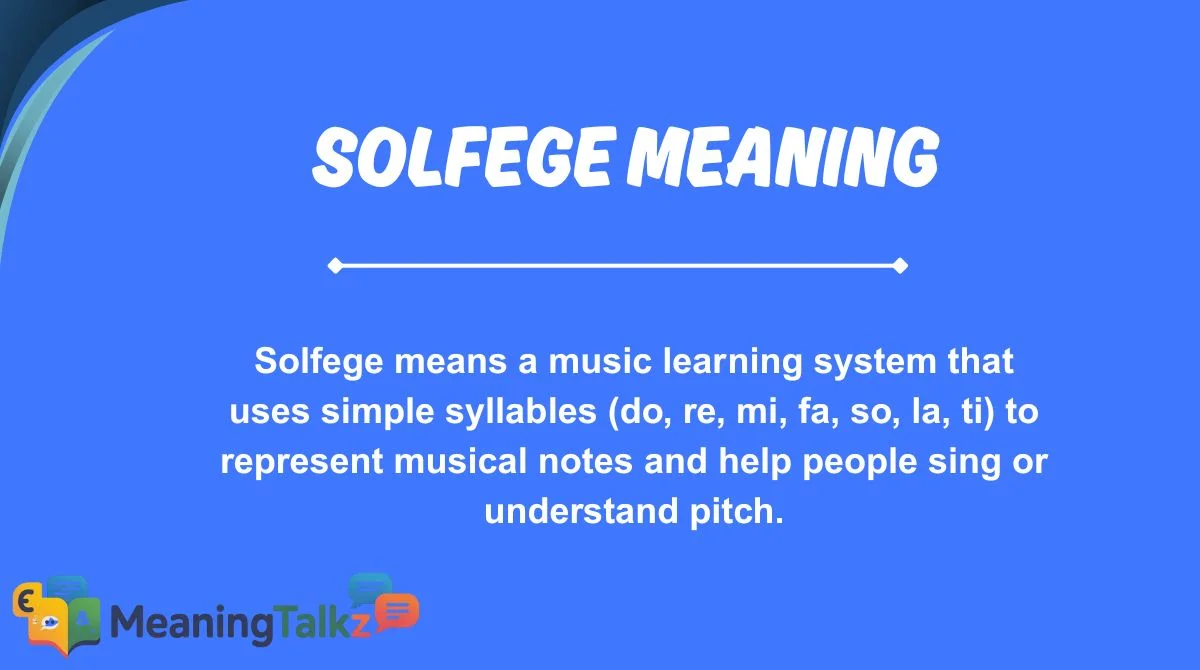
Solfege means a music learning system that uses simple syllables (do, re, mi, fa, so, la, ti) to represent musical notes and help people sing or understand pitch.
People may use the term in a few ways:
- A method for learning music notes
- A tool for training the ear in singing
- A system used in choir practice
- A way to teach children basic music skills
In short, solfege turns complicated music theory into easy sounds.
What Is the Difference Between Fixed-Do and Movable-Do Solfege?

Solfege does not always work the same way in every music program. Two common approaches are fixed-do and movable-do. In fixed-do, “do” corresponds to the note C, “re” to D, and so on, regardless of the key. In movable-do, “do” represents the first or tonic note of the current key. For example, in G major, G is treated as “do.” This makes movable-do especially useful for understanding intervals and the relationships between notes. Both systems are recognized in formal music training, so the meaning of a solfege syllable can depend on which system a teacher or musician uses.
Where Did “Do Re Mi” Come From?

The familiar do, re, mi, fa, sol, la, ti syllables have a long history in Western music education. They developed from an older system of syllables used to help singers learn melodies and remember pitch relationships. Over time, the system evolved into the solfege used today, with different traditions using slightly different syllables, such as “so” or “sol” and “ti” or “si.” This is why you may see variations when learning music in different countries or teaching systems. The important idea is that solfege gives singers convenient syllables for reading, practicing, and hearing musical relationships rather than being a separate spoken language.
The Most Common Meanings of “Solfege Meaning”
1. A System for Learning Musical Notes
The most common meaning of solfege is a teaching system for music notes.
Instead of starting with written notes like C, D, E, F, teachers begin with syllables:
- Do
- Re
- Mi
- Fa
- So
- La
- Ti
Each syllable matches a note in a musical scale.
Example:
A teacher may say:
“Sing the scale: do, re, mi, fa, so, la, ti, do.”
This helps students understand how notes move upward.
2. A Tool for Training the Musical Ear
Solfege is also used to develop ear training.
Ear training means learning to recognize notes by sound alone.
With solfege, singers can hear patterns more clearly.
Example:
If a singer hears:
“do – mi – so”
They understand the melody shape without seeing sheet music.
This helps musicians learn songs faster.
3. A Singing Practice Method
Choirs and vocal groups often practice songs using solfege first.
Instead of lyrics, they sing the notes.
Example:
Instead of singing words, they sing:
“do re mi mi re do.”
This helps the group focus on pitch accuracy.
Many professional choirs still use this method.
4. A Basic Music Teaching Tool for Kids
Solfege is extremely common in children’s music education.
Young learners find it easier to sing syllables than read notes.
A famous example appears in the song **Do‑Re‑Mi from the movie The Sound of Music, which teaches the scale through a catchy melody.
Because the sounds are simple, kids remember them quickly.
How “Solfege Meaning” Is Used in Real Conversations
Even though solfege is a music term, people mention it in different types of conversations.
Friends & Casual Texting
Among friends who study music, solfege may come up in casual chat.
Example messages:
- “Our teacher made us sing solfege again today.”
- “I finally memorized do re mi.”
Sometimes people jokingly use it when someone sings badly.
Example:
“Bro that note was NOT ‘do’.”
Instagram & Snapchat
Music students often post practice clips.
Captions may include:
- “Solfege warmup today”
- “Practicing do re mi scales”
- “Ear training using solfege”
Music education creators also teach the method in short videos.
Dating Apps
This is less common, but musicians sometimes mention it in bios.
Example:
“Choir singer who can sight-sing solfege.”
This tells other musicians they have strong music skills.
Gaming & Online Communities
In creative communities like music production forums, solfege may appear when discussing melody.
Example:
“A good hook could be do-mi-so pattern.”
Gamers who compose background music also use it.
Work or Professional Chat
In professional music settings, solfege appears often.
Examples:
- Choir rehearsals
- Music school classes
- Vocal training sessions
A director might say:
“Let’s sing the passage in solfege first.”
This helps singers lock in the correct pitch.
Is “Solfege” Rude, Flirty, or Offensive?
Solfege is not rude, flirty, or offensive.
It is a neutral educational term.
However, tone can change depending on how it is used.
Positive Tone
Most of the time, the word feels positive or educational.
Example:
“Solfege really helped my pitch.”
This shows improvement in music skills.
Playful or Funny Tone
Friends may joke about it.
Example:
“Sing it in solfege if you’re a real musician.”
This is usually playful.
Slightly Negative Tone
Sometimes people say it when complaining about music class.
Example:
“Another hour of solfege practice.”
Even here, the word itself is not offensive.
It simply describes the training method.
How to Respond When Someone Says “Solfege”
Your response depends on the situation.
Casual Replies
These work in normal conversation.
Examples:
- “Yeah, do re mi right?”
- “That’s the singing scale.”
- “It helps with pitch.”
Funny Replies
Humor works well with friends.
Examples:
- “Do re mi… now I’m singing.”
- “Only if you start with do.”
- “Don’t make me sing the whole scale.”
Neutral Replies
Good for learning conversations.
Examples:
- “That’s the music note system.”
- “It helps train the ear.”
- “Choirs use it a lot.”
Professional Replies
Used in school or music discussions.
Examples:
- “Solfege improves sight-singing.”
- “It helps singers recognize pitch patterns.”
- “We use movable-do solfege.”
These responses show deeper understanding.
Common Misunderstandings About “Solfege Meaning”
Many people misunderstand what solfege really is.
Mistake 1: Thinking It Is a Language
Some beginners think solfege is a foreign language.
It is not.
It is simply syllables representing notes.
Mistake 2: Thinking It Is Only for Kids
Many assume solfege is just for elementary music classes.
In reality, professional musicians still use it.
Opera singers, choir directors, and composers rely on it.
Mistake 3: Thinking It Replaces Music Notes
Solfege does not replace real notes like C, D, and E.
It works alongside them.
Think of it as a training shortcut.
Mistake 4: Confusing It With Random Singing
Solfege follows strict note patterns.
It is not random sounds.
Each syllable represents a specific pitch in the scale.
Similar Slang Terms You Should Know
These music and internet terms often appear near discussions of solfege.
Sight-singing
Singing music directly from sheet notation.
Pitch
How high or low a musical note sounds.
Scale
A sequence of notes arranged from low to high.
Ear training
Exercises that improve the ability to recognize notes by sound.
Harmony
When multiple notes sound together.
Melody
The main musical line of a song.
Vocal warm-up
Exercises singers use before performing.
Key
The tonal center of a piece of music.
Interval
The distance between two musical notes.
Chord
Three or more notes played together.
When You Should Avoid Using “Solfege”
Even though solfege is harmless, there are times it may confuse people.
Professional Settings Outside Music
In non-music workplaces, most people may not understand the term.
Example:
Instead of saying:
“Use solfege.”
Say:
“Use the musical scale.”
Cross-Cultural Conversations
Some cultures teach music differently.
They may use:
- numeric systems
- letter notes
- alternative syllables
Explaining the concept helps avoid confusion.
Sensitive Learning Situations
Beginners may feel embarrassed if they struggle with singing.
Avoid saying things like:
“You should know solfege already.”
Instead encourage learning.
Final Thoughts.
The solfege meaning is simple once you understand it.
Solfege is a music learning system that uses syllables like do, re, mi, fa, so, la, ti to represent notes in a scale. It helps singers recognize pitch, understand melody, and improve their musical ear.
Music teachers use it because it makes learning faster and easier. Children, beginners, choir singers, and professional musicians all benefit from it.
Instead of memorizing complex symbols first, learners start with simple sounds. That makes the process more natural and enjoyable.
If you ever hear someone singing “do re mi,” now you know exactly what is happening. They are using one of the most effective music training tools in the world.
Understanding solfege helps you appreciate how music is taught and why singers use these sounds during practice.
FAQs
What is the simple meaning of solfege?
Solfege is a music system that uses syllables like do, re, mi, fa, so, la, ti to represent notes in a scale and help people learn singing and pitch.
Why do music teachers use solfege?
Teachers use solfege because it helps students hear pitch relationships and understand melodies without needing complex sheet music at the start.
Is solfege the same as do re mi?
Yes. “Do re mi” is the beginning of the solfege scale. The full sequence is do, re, mi, fa, so, la, ti, do.
Do professional singers still use solfege?
Yes. Choir singers, vocal coaches, and music students regularly use solfege for ear training and sight-singing practice.
Is solfege difficult to learn?
No. Most people learn the basics quickly because the syllables are simple and follow a clear pattern.
What is movable do in solfege?
Movable do means the syllable “do” represents the first note of whatever key a song is in, instead of always being the same pitch.
Can solfege help beginners learn music faster?
Yes. Solfege helps beginners recognize pitch patterns quickly, which improves singing accuracy and musical understanding.
Conclusion
Understanding the solfege meaning opens the door to learning music in a simple and powerful way. Instead of struggling with complex notation at the beginning, solfege lets learners focus on sound, pitch, and melody through easy syllables like do, re, mi.
This method has helped singers, students, and musicians for generations because it trains the ear and builds musical confidence.
Whether you are learning to sing, studying music, or just curious about the famous “do re mi” scale, solfege remains one of the most effective tools for understanding how music works.