Have you ever opened a text message and seen someone write “SMT,” then wondered what it meant?
You’re not alone. Social media, texting apps, gaming chats, and online communities create new slang every day. Sometimes a short abbreviation can have several meanings, which makes conversations confusing.
That’s exactly why many people search for “smt meaning in text.”
The meaning of SMT depends heavily on the situation, platform, and the people involved in the conversation. In one chat, it may mean one thing, while in another, it could mean something completely different.
Understanding internet slang helps you avoid awkward misunderstandings and communicate more naturally online.
Whether you saw SMT on Snapchat, Instagram, TikTok comments, Discord, gaming chats, or a text message from a friend, knowing its meaning can save you from guessing.
In this guide, you’ll learn the most common SMT meanings, how people use it in real conversations, whether it’s rude or offensive, how to respond, common mistakes people make, and other popular slang terms you should know in 2026.
What Does “SMT Meaning in Text” Mean in Text?
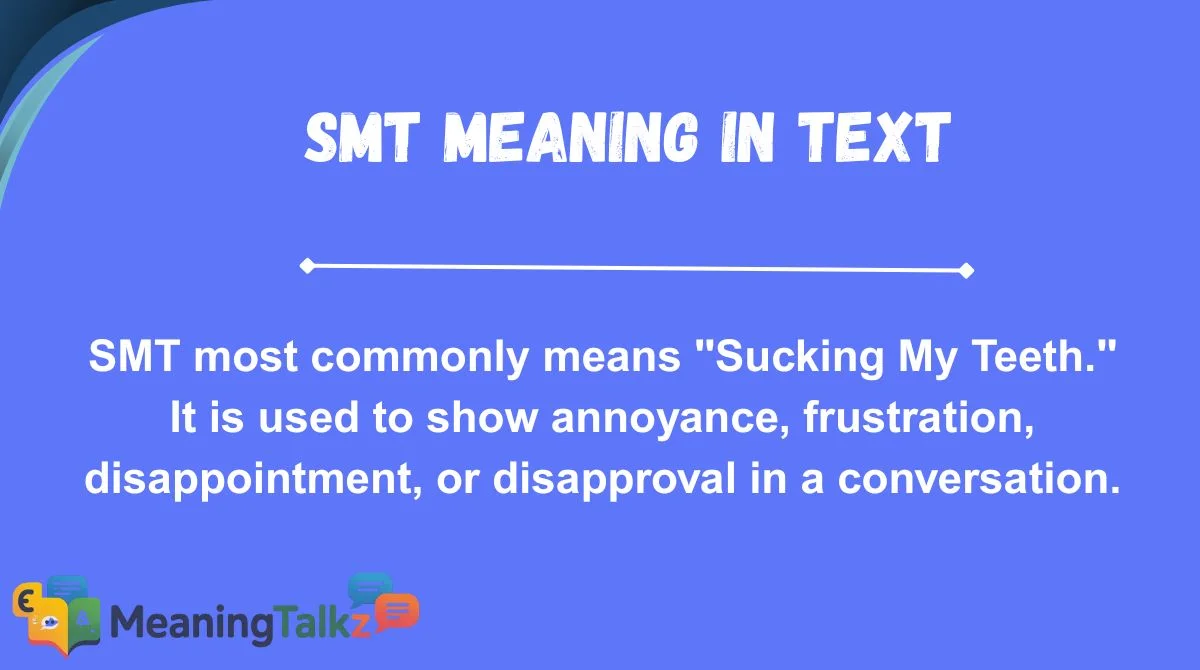
SMT most commonly means “Sucking My Teeth.” It is used to show annoyance, frustration, disappointment, or disapproval in a conversation.
Depending on the context, SMT can also mean:
- Something
- Send Me That
- Smiling To Myself
- Various niche meanings in gaming or online communities
The intended meaning usually becomes clear from the surrounding conversation.
The Most Common Meanings of “SMT”
1. Sucking My Teeth
This is the most widely recognized meaning online.
“Sucking my teeth” refers to a sound people make to express irritation, annoyance, frustration, or disagreement.
Example:
Person A: “I forgot your birthday again.”
Person B: “SMT.”
Here, SMT shows annoyance or disappointment.
When It’s Used
- Someone is frustrated
- Someone disagrees
- Someone feels annoyed
- Someone is expressing silent criticism
2. Something
Many texters use SMT as a shortened version of “something.”
Example:
“I feel like SMT is missing.”
Translation:
“I feel like something is missing.”
When It’s Used
- Casual texting
- Fast conversations
- Social media comments
- Informal chats
This usage is especially common among younger users who shorten words to type faster.
3. Send Me That
Sometimes SMT stands for “Send Me That.”
Example:
Person A: “I found the video.”
Person B: “SMT.”
Translation:
“Send me that.”
When It’s Used
- Snapchat
- Instagram DMs
- TikTok messages
- Friend group chats
4. Smiling To Myself
A less common meaning is “Smiling To Myself.”
Example:
“Thinking about what happened yesterday, SMT.”
Translation:
“Thinking about what happened yesterday, smiling to myself.”
When It’s Used
- Flirty conversations
- Positive memories
- Romantic texting
- Personal reflections
5. Gaming-Specific Meanings
In gaming communities, SMT can occasionally have game-related meanings depending on the title or group.
Players often create custom abbreviations that differ from mainstream texting slang.
Example
A gaming clan may use SMT as an internal shorthand that only members understand.
Always look at the surrounding conversation before assuming the meaning.
How “SMT” Is Used in Real Conversations
Friends & Casual Texting
Among friends, SMT is usually used to show annoyance or refer to “something.”
Examples
“I know SMT is wrong.”
“SMT, you never listen.”
“I forgot SMT important.”
In casual texting, abbreviations help conversations move quickly.
Instagram & Snapchat
Instagram and Snapchat users frequently use SMT in comments, captions, stories, and direct messages.
Examples
“Girl, SMT is not adding up.”
“SMT funny happened today.”
“SMT.”
The meaning often depends on the tone and context of the post.
Dating Apps
Dating conversations can introduce different interpretations.
Examples
“I saw your picture and SMT.”
This could mean:
- Smiling To Myself
- Feeling a certain way
- Thinking about something positive
Another example:
“You canceled again? SMT.”
Here it likely expresses annoyance.
Context is everything.
Gaming & Online Communities
Gamers often use abbreviations to communicate quickly during matches.
Examples
“Need SMT for this mission.”
“SMT isn’t working.”
Depending on the game, SMT may simply mean “something” or a community-specific phrase.
Always consider the discussion topic.
Work or Professional Chat
SMT is generally uncommon in professional communication.
Example
Instead of:
“Need SMT from you.”
Write:
“I need something from you.”
Professional messages should prioritize clarity over slang.
Is “SMT” Rude, Flirty, or Offensive?
The answer depends on context.
When SMT Feels Positive
- Smiling To Myself
- Friendly conversations
- Playful interactions
- Lighthearted chats
Example
“Thinking about our date, SMT.”
This sounds warm and positive.
When SMT Feels Negative
If SMT means “Sucking My Teeth,” it often signals annoyance.
Example
“You forgot again? SMT.”
This can feel critical or disappointed.
Is It Offensive?
Usually, no.
However, it may come across as disrespectful if used toward someone in an argument.
The abbreviation itself is not offensive, but the attitude behind it may seem rude.
Is It Flirty?
It can be.
When SMT means “Smiling To Myself,” it may suggest:
- Attraction
- Affection
- Positive feelings
- Romantic interest
Again, context determines the meaning.
How to Respond When Someone Says “SMT”
Casual Replies
If SMT means “something.”
Examples
- “What something?”
- “Tell me more.”
- “What do you mean?”
Funny Replies
If the meaning is unclear.
Examples
- “Decode that for me.”
- “You lost me there.”
- “What does SMT mean this time?”
Neutral Replies
Useful when you’re unsure.
Examples
- “Can you explain?”
- “What are you referring to?”
- “I don’t follow.”
Professional Replies
If someone uses SMT at work.
Examples
- “Could you clarify that?”
- “Can you provide more details?”
- “What exactly do you mean?”
Professional communication should always favor clear language.
Common Misunderstandings About “SMT”
Assuming It Always Means One Thing
Many people think SMT only means “Sucking My Teeth.”
In reality, it has multiple meanings.
Ignoring Context
Context is the biggest clue.
The same abbreviation can mean different things in different conversations.
Confusing It With Similar Slang
Many internet abbreviations look alike.
For example:
- SMT
- SMH
- IMO
- TBH
Mixing them up can completely change a message’s meaning.
Reading the Wrong Tone
Someone may use SMT jokingly.
Another person may read it as criticism.
Tone is often difficult to understand through text alone.
Assuming It’s Universal
Not everyone uses SMT the same way.
Different countries, age groups, and online communities may interpret it differently.
Similar Slang Terms You Should Know
SMH
Shaking My Head; shows disappointment or disbelief.
TBH
To Be Honest; introduces an honest opinion.
IMO
In My Opinion; shares a personal view.
IDK
I Don’t Know; expresses uncertainty.
NGL
Not Gonna Lie; introduces a truthful statement.
FR
For Real; emphasizes sincerity.
ICYMI
In Case You Missed It; highlights missed information.
FOMO
Fear Of Missing Out; anxiety about missing experiences.
TMI
Too Much Information; shares more than needed.
WYD
What You Doing; asks what someone is doing.
BRB
Be Right Back; indicates a short absence.
OMW
On My Way; tells someone you’re heading somewhere.
When You Should Avoid Using “SMT”
Professional Settings
Business communication should remain clear and direct.
Avoid abbreviations that may confuse colleagues.
Instead of SMT, use complete words.
Cross-Cultural Chats
Internet slang varies by country.
Someone from another region may not understand SMT at all.
Using plain language reduces confusion.
Sensitive Situations
If discussing serious topics, abbreviations can seem careless.
Examples include:
- Family emergencies
- Workplace conflicts
- Emotional conversations
- Important announcements
Clear communication is usually better.
Formal Writing
Avoid SMT in:
- Academic papers
- Reports
- Business proposals
- Professional emails
Formal writing requires complete words.
Customer Communication
Businesses should avoid unclear slang when talking to customers.
Clear messages create trust and reduce misunderstandings.
Final Thoughts.
SMT is a short abbreviation with several possible meanings, but “Sucking My Teeth” is the most common interpretation in texting and social media conversations. Depending on the situation, it can also mean Something, Send Me That, or Smiling To Myself.
The key to understanding SMT is context. Look at the conversation, tone, platform, and relationship between the people involved before deciding what it means.
As internet slang continues to evolve in 2026, knowing terms like SMT can help you communicate more confidently and avoid misunderstandings.
The next time you see SMT in a text, you’ll have a much better idea of what the sender is trying to say.
FAQs
What does SMT stand for in texting?
SMT most commonly stands for “Sucking My Teeth,” but it can also mean Something, Send Me That, or Smiling To Myself.
Is SMT a bad word?
No. SMT is not considered a bad word, although it may express annoyance depending on the context.
What does SMT mean on Snapchat?
On Snapchat, SMT often means Sucking My Teeth, Something, or Send Me That.
What does SMT mean from a girl?
It depends on the conversation. It may express frustration, refer to something, or mean Smiling To Myself.
What does SMT mean on Instagram?
Instagram users commonly use SMT to mean Something or Sucking My Teeth in comments and direct messages.
Can SMT be flirty?
Yes. If SMT means Smiling To Myself, it can carry a playful or romantic tone.
Should I use SMT in professional communication?
No. Professional communication is usually clearer when you use complete words instead of slang abbreviations.
At the provide me Conclusion paragraph.
Understanding the SMT meaning in text is easier once you know that context determines everything. While “Sucking My Teeth” remains the most common meaning, SMT can also represent Something, Send Me That, or Smiling To Myself depending on the conversation.
Before reacting, always look at the surrounding message and the relationship between the people chatting.
By learning common texting slang like SMT, you can read messages more accurately, avoid misunderstandings, and communicate more naturally across social media, texting apps, gaming communities, and everyday online conversations.