Last updated on September 5th, 2026 at 11:25 am
You send a message. You wait for a reply.
Then the other person answers with just one letter:
“k”
Now your brain starts spinning.
Are they annoyed?
Are they being rude?
Did you say something wrong?
Or are they just busy?
This tiny reply confuses millions of people every day. That is why so many users search for k meaning in text when they see it in chats, social media messages, or dating apps.
The truth is simple: the meaning of “k” depends heavily on tone, context, and the relationship between people in the conversation. Sometimes it is friendly. Sometimes it feels cold. And sometimes it is just the fastest reply someone can send.
In this guide, you will learn the real meaning of “k” in text, how people actually use it in modern messaging, when it sounds rude, and how to respond without making the situation awkward.
By the end, you will never feel confused by a single-letter reply again.
What Does “k” Mean in Text?
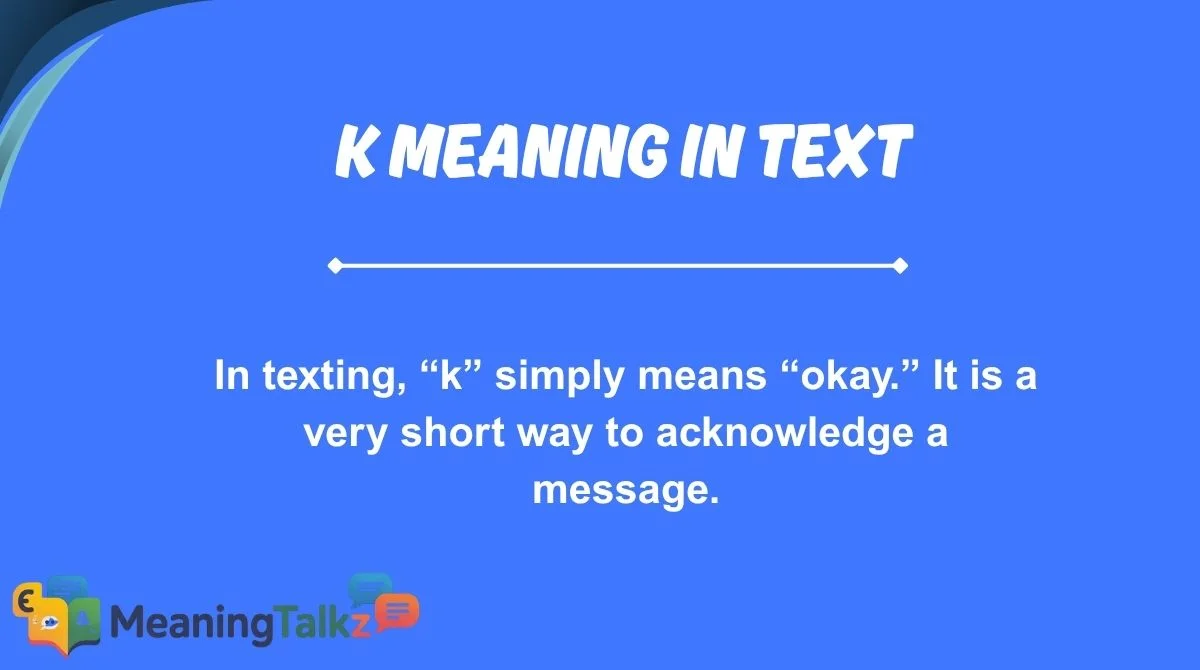
In texting, “k” simply means “okay.” It is a very short way to acknowledge a message.
People use it to confirm they understand something or agree with what was said. However, depending on tone and context, it can also feel dismissive, uninterested, or slightly annoyed.
Common interpretations include:
- Okay / understood
- Agreement
- Quick acknowledgment
- Cold or annoyed response
What Does “K” Mean From a Crush?
If your crush replies with “k,” it does not automatically mean they are angry, uninterested, or rejecting you. The basic meaning is still “okay,” but the short reply can feel different depending on what happened before it.
For example:
You: “I can meet you after work.”
Them: “k”
This could simply mean they agree with the plan. But if the conversation was emotional and they suddenly switch from longer messages to “k,” it may suggest they are annoyed or want to end the conversation.
The best approach is to look at their overall texting behavior, not one message. If they normally engage with you, ask questions, and keep conversations going, a single “k” probably does not mean much.
“K” vs. “OK” vs. “KK”: What’s the Difference?
Although “k,” “ok,” and “kk” can all mean “okay,” they may create slightly different impressions in texting.
“K” is the shortest and can sometimes feel abrupt or cold.
“OK” feels more neutral and straightforward. It is often a safer choice when you simply want to acknowledge something.
“KK” is commonly used in casual conversations and can feel more relaxed or friendly.
For example:
“I’ll see you at 7.”
“K” → very brief acknowledgment
“OK” → neutral confirmation
“KK” → casual, friendly confirmation
These differences are not strict rules. People have different texting habits, so the surrounding conversation matters more than the letters themselves.
The Most Common Meanings of “k”
Even though it is only one letter, “k” can carry different meanings depending on how it is used.
1. Simple Acknowledgment
Most of the time, “k” just means “okay, I got your message.”
People send it when they want to confirm something quickly without typing a full sentence.
Example:
Friend:
“Meeting is at 6.”
Reply:
“K”
Meaning: message received.
There is no emotion here. It is simply fast communication.
2. Agreement
Sometimes “k” means the person agrees with a plan or suggestion.
Example:
“You want pizza tonight?”
“K”
This usually means yes.
However, because the response is short, some people may still feel unsure about the tone.
3. Quick Reply When Busy
Many people type “k” when they are busy or multitasking.
They may be:
- Working
- Driving
- In a meeting
- Playing a game
- Talking to someone in real life
Instead of writing “okay,” they type one letter.
Example:
“Can you send the file later?”
“K”
This means: okay, I will.
4. Slight Annoyance
In some cases, “k” can signal mild frustration.
When someone normally types full messages but suddenly replies with “k,” it may show they are not happy.
Example:
“I forgot to finish the task.”
“K”
The tone can feel cold.
It may mean: “I saw your message, but I’m not pleased.”
5. Conversation Ender
Sometimes “k” is used to end a conversation quickly.
Example:
“Alright, talk later.”
“K”
This usually signals the chat is finished.
How “k” Is Used in Real Conversations
The meaning of “k” changes depending on where the conversation happens.
Friends & Casual Texting
Among friends, “k” is extremely common.
It often means:
- Got it
- Okay
- Sure
- Sounds good
Example:
“Movie starts at 8.”
“K”
Friends usually do not read too much into it.
However, if someone normally texts a lot and suddenly sends “k,” friends may wonder if something is wrong.
Instagram & Snapchat
On social media platforms, short replies are normal.
People often respond with:
- k
- ok
- kk
- kkk
- k cool
Example:
“Send the video later.”
“K”
Here it simply confirms the message.
On Snapchat especially, fast replies are common because conversations move quickly.
Dating Apps
In dating conversations, “k” can feel different.
Because tone matters a lot in dating, a one-letter reply may seem:
- uninterested
- bored
- annoyed
Example:
“You want to meet this weekend?”
“K”
That answer feels vague. It may confuse the other person.
Many people prefer clearer responses like:
“Okay sure”
or
“Yeah that works.”
Gaming & Online Communities
In gaming chats, speed matters more than tone.
Players often type:
- k
- kk
- ok
- go
Example:
“Start the match.”
“K”
This simply confirms readiness.
No one usually reads emotion into it.
Work or Professional Chat
In professional chats, “k” can sometimes feel too short.
Example:
Manager:
“Please send the report today.”
Employee:
“K”
This might appear unprofessional or careless.
A better reply would be:
“Okay, I’ll send it today.”
Short replies are fine in quick team chats, but context matters.
Is “k” Rude, Flirty, or Offensive?
“K” is not automatically rude. But it can feel rude depending on tone.
When It Feels Neutral
It is neutral when:
- the conversation is casual
- both people use short replies
- the message only needs confirmation
Example:
“Dinner at 7.”
“K”
No negative meaning.
When It Feels Slightly Rude
It may feel rude when:
- someone expected a longer reply
- the conversation was emotional
- the sender suddenly became short
Example:
“I’m really stressed about work.”
“K”
This response feels dismissive.
When It Feels Cold
Sometimes “k” signals emotional distance.
Example:
“I’m sorry about earlier.”
“K”
The person may still be upset.
Is It Ever Flirty?
Rarely.
“K” usually does not carry flirty energy.
Flirty texting tends to include:
- emojis
- jokes
- longer responses
- playful tone
A single “k” is too neutral to sound romantic.
How to Respond When Someone Says “k”
If someone replies with “k,” you have several ways to respond depending on the situation.
Casual Replies
If the conversation is normal, you can continue naturally.
Examples:
“Cool, see you later.”
“Alright.”
“Thanks.”
“Sounds good.”
Funny Replies
If you want to lighten the mood:
“Wow that was a powerful response.”
“Such deep conversation.”
“Best reply ever.”
These responses are playful and often make people laugh.
Neutral Replies
Sometimes it is best not to overthink it.
Examples:
“Alright.”
“Talk later.”
“Got it.”
These keep the conversation calm.
Professional Replies
If you are in a work chat, stay clear and polite.
Example responses:
“Okay, thank you.”
“Understood.”
“Will do.”
Professional communication works best with clarity.
Common Misunderstandings About “k”
Many people misunderstand the tone of this tiny message.
Here are some common mistakes.
Assuming Someone Is Angry
Many people think:
“k = anger”
But often the sender is simply busy.
Short messages are normal in fast chats.
Thinking It Means Rejection
If someone replies “k” to a suggestion, it does not always mean they dislike the idea.
Example:
“Let’s meet tomorrow.”
“K”
They likely mean yes.
Confusing It With “K.”
Adding a period can change tone.
Example:
“K.”
This may feel more serious or passive-aggressive.
Punctuation changes how text feels.
Reading Too Much Into It
Text messages lack facial expression and voice tone.
Because of this, people often misread simple replies.
Not every short message carries hidden meaning.
Similar Slang Terms You Should Know
Modern texting includes many short replies like “k.”
Here are some common ones.
ok
The full version of “k.” Slightly more polite.
kk
Friendly confirmation. Often used in gaming.
k cool
Means okay and sounds positive.
bet
Means agreement or approval.
gotcha
Shows understanding.
sure
Confirms a plan.
alr
Short for “alright.”
np
Means “no problem.”
idk
Means “I don’t know.”
ty
Short for “thank you.”
brb
Means “be right back.”
Learning these helps you understand modern texting faster.
When You Should Avoid Using “k”
Even though “k” is common, there are situations where it is better not to use it.
Professional Settings
In work conversations, clarity matters.
“K” may look careless.
Better alternatives include:
“Okay, thank you.”
“Understood.”
“I’ll handle it.”
Cross-Cultural Conversations
People from different cultures may interpret short replies differently.
Some may see “k” as disrespectful.
Longer replies reduce confusion.
Emotional Conversations
If someone shares feelings or serious news, avoid short responses.
Example:
“I’m feeling really upset today.”
Replying “k” can feel insensitive.
Better responses include:
“I’m sorry to hear that.”
“Do you want to talk?”
Sensitive Situations
During arguments or misunderstandings, “k” may make things worse.
It can sound dismissive.
A thoughtful response works better.
Final Thoughts
The k meaning in text is simple but powerful.
At its core, “k” means okay or message received. It is one of the fastest replies people use in modern messaging.
However, tone changes everything.
With friends, it usually feels normal.
In dating conversations, it may seem uninterested.
In work chats, it can appear unprofessional.
The key is context.
Before assuming someone is angry or rude, think about the situation, the relationship, and how that person usually texts.
Understanding small texting habits like this helps you communicate more clearly and avoid unnecessary misunderstandings.
FAQs
Why do people reply with just “k”?
People use “k” because it is fast. It confirms they saw a message without typing a full word like “okay.”
Is replying “k” considered rude?
Not always. It depends on context. With friends it is normal, but in serious conversations it may feel cold or dismissive.
What is the difference between “k” and “ok”?
“Ok” feels slightly more polite and neutral, while “k” is shorter and can sometimes sound more abrupt.
Does “k” mean someone is mad?
Sometimes, but not usually. Most of the time it simply means “okay” or “message received.”
What does “k.” mean with a period?
“K.” can feel more serious or passive-aggressive because punctuation in texting often changes the tone.
Is “k” common in modern texting?
Yes. It is extremely common in quick conversations, gaming chats, and social media messaging.
Should I use “k” in work messages?
It is better to avoid it in professional communication. Using full replies like “okay” or “understood” sounds more professional.
Conclusion
The k meaning in text is simple: it stands for “okay.” But the tone behind it can change depending on the situation.
Among friends, it is just a quick reply. In dating chats, it may feel uninterested. In professional messages, it can appear too casual.
The smartest approach is to read the context before reacting. Not every short reply hides a negative meaning.
When you understand how modern texting works, even a single letter like “k” becomes easy to interpret.