People send short text messages every day, but not every abbreviation is easy to understand. You might open a message, see “IMY,” and wonder what the sender is trying to say.
That confusion is exactly why so many people search for imy meaning in text. Texting slang changes fast, and new users on social media, dating apps, gaming platforms, and messaging apps often come across abbreviations they have never seen before.
The good news is that IMY is actually one of the easiest texting terms to understand once you know the meaning. Still, context matters. Depending on who sends it and where it appears, the tone can feel friendly, emotional, romantic, or even casual.
In this guide, you’ll learn exactly what IMY means, how people use it in real conversations, whether it sounds flirty or rude, how to reply to it, common misunderstandings, related slang terms, and situations where you may want to avoid using it.
By the end, you’ll know how to read and use IMY with confidence in any conversation.
What Does “IMY” Mean in Text?
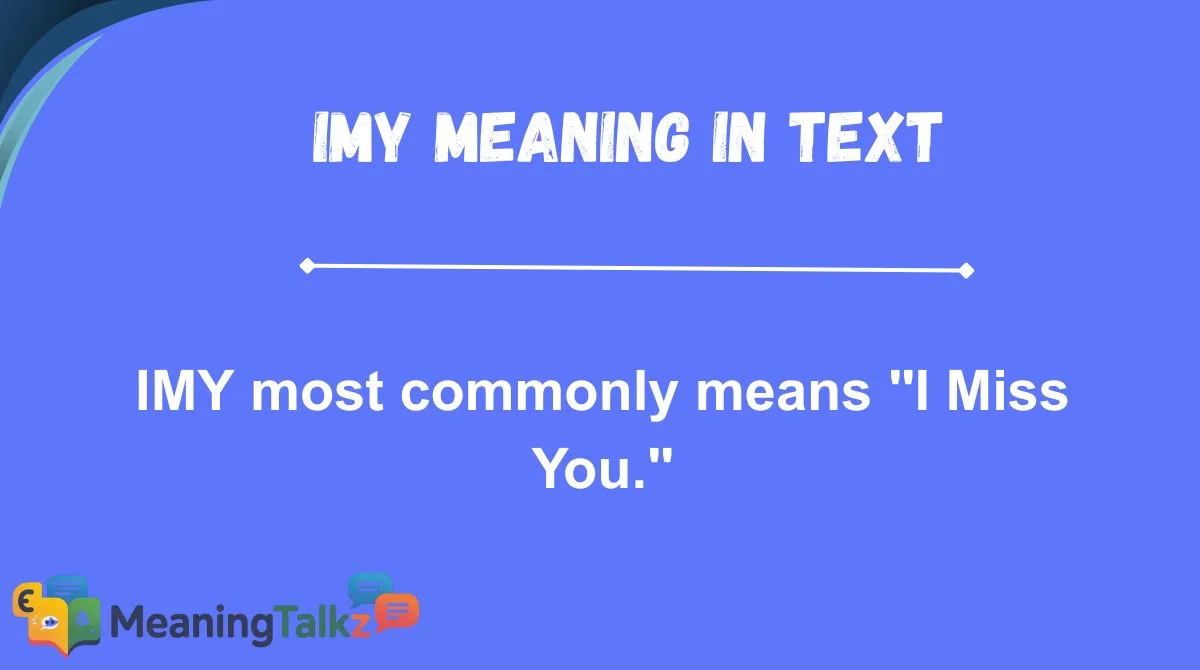
IMY most commonly means “I Miss You.”
It is a popular texting abbreviation used when someone wants to tell another person that they miss them. The phrase is often used between friends, family members, romantic partners, and close online friends.
Other less common interpretations may include:
- I Miss Ya
- I Miss You Too (when used as a quick response)
- A playful or emotional way to reconnect
- Casual expression of affection
In most situations, if someone texts “IMY,” they simply mean they miss you.
The Most Common Meanings of “IMY”
I Miss You
This is by far the most common meaning.
People use IMY when they have not seen or spoken to someone for a while and want to express that feeling.
Examples:
- “It’s been weeks. IMY.”
- “IMY so much.”
- “Can’t wait to see you. IMY.”
I Miss Ya
Some people use IMY as a shorter version of “I miss ya.”
The meaning stays the same, but the tone feels more casual and friendly.
Examples:
- “Hey, IMY.”
- “IMY buddy.”
Romantic Expression
In dating and relationships, IMY often carries a stronger emotional meaning.
It can show affection, attachment, and emotional connection.
Examples:
- “Good night. IMY.”
- “Wish you were here. IMY.”
Friendly Reconnection
Sometimes IMY is not deeply emotional. It simply acts as a conversation starter.
Examples:
- “Haven’t talked in forever. IMY.”
- “Where have you been? IMY.”
How “IMY” Is Used in Real Conversations
Friends & Casual Texting
Friends often use IMY when they have not spent time together recently.
The message usually feels warm and friendly rather than romantic.
Example:
Friend 1: “Been busy lately.”
Friend 2: “Yeah, IMY. Let’s hang out soon.”
In these situations, IMY helps maintain friendships and show appreciation.
Instagram & Snapchat
On Instagram and Snapchat, IMY appears in:
- Direct messages
- Story replies
- Comments
- Private chats
People often send it after seeing an old photo, memory, or story update.
Example:
“Just saw your vacation pics. IMY.”
The tone is usually emotional, friendly, or nostalgic.
Dating Apps
Dating app users frequently use IMY after building a connection.
When someone you’ve been talking to sends IMY, they are often signaling emotional interest.
Example:
“We haven’t talked much today. IMY.”
This can indicate attraction or growing feelings.
Gaming & Online Communities
Online friends can become close over time.
Gamers sometimes use IMY when a regular teammate has been offline.
Example:
“Bro, haven’t seen you online in weeks. IMY.”
Here, the meaning is usually friendship and appreciation.
Work or Professional Chat
IMY is uncommon in professional environments.
While close coworkers may occasionally use it, it generally feels too personal for workplace communication.
Example:
A coworker saying:
“IMY in the office.”
This might be acceptable among close colleagues but not in formal business conversations.
Is “IMY” Rude, Flirty, or Offensive?
In most situations, IMY is not rude or offensive.
The phrase is generally viewed as positive because it communicates affection, appreciation, or emotional connection.
When It Feels Positive
IMY feels positive when:
- Sent by friends
- Sent by family members
- Used in healthy relationships
- Shared after a period of absence
Example:
“IMY. Hope you’re doing well.”
This feels caring and supportive.
When It Feels Flirty
IMY often sounds flirty when:
- Used between romantic interests
- Sent late at night
- Combined with compliments
- Used frequently in private conversations
Example:
“IMY already.”
This can signal romantic attraction.
When It May Feel Negative
Sometimes IMY can create pressure.
For example:
- After an argument
- During a breakup
- When communication is one-sided
In these situations, the recipient may interpret the message differently depending on the relationship.
Is It Offensive?
Generally, no.
IMY is considered one of the most harmless and friendly abbreviations used in texting culture.
How to Respond When Someone Says “IMY”
Your response should match the relationship and tone.
Casual Replies
- “IMY too.”
- “Miss you too.”
- “We should catch up soon.”
- “It’s been a while.”
Funny Replies
- “Miss me already?”
- “I know, I’m unforgettable.”
- “The legend returns.”
- “Finally someone admits it.”
Neutral Replies
- “Hope you’re doing well.”
- “Nice hearing from you.”
- “Been busy lately.”
- “Thanks for checking in.”
Professional Replies
Professional situations rarely require IMY responses, but if needed:
- “Looking forward to reconnecting.”
- “Hope everything is going well.”
- “It’ll be good to see everyone again.”
These replies maintain professionalism while acknowledging the message.
Common Misunderstandings About “IMY”
Assuming It Is Always Romantic
One of the biggest mistakes is thinking IMY automatically means romantic interest.
Friends, family members, classmates, and coworkers can also use it.
Believing It Shows Deep Feelings
Sometimes IMY is simply a friendly gesture.
Not every use indicates strong emotional attachment.
Confusing It With Similar Terms
People occasionally mix IMY with other abbreviations.
For example:
- ILY = I Love You
- ILYSM = I Love You So Much
- IMU = I Miss You
Although related, they carry different emotional levels.
Misreading Tone
Text messages lack facial expressions and voice tone.
As a result, the same IMY message can feel:
- Friendly
- Romantic
- Casual
- Emotional
Context usually reveals the intended meaning.
Similar Slang Terms You Should Know
Here are related texting abbreviations commonly used alongside IMY.
ILY
I Love You.
ILYSM
I Love You So Much.
IMU
I Miss You.
HBU
How About You?
WYD
What Are You Doing?
BRB
Be Right Back.
TTYL
Talk To You Later.
IDK
I Don’t Know.
TBH
To Be Honest.
BFF
Best Friends Forever.
OMW
On My Way.
SMH
Shaking My Head.
Learning these abbreviations can help you understand modern texting conversations more easily.
When You Should Avoid Using “IMY”
Although IMY is generally harmless, there are situations where it may not be appropriate.
Professional Settings
Business communication should remain professional.
Using IMY in emails, client messages, or workplace chats may seem overly personal.
Better alternatives include:
- “Looking forward to reconnecting.”
- “Hope you’re doing well.”
Cross-Cultural Chats
Not everyone understands English texting slang.
Using IMY with international contacts may cause confusion.
In these cases, writing the full phrase “I miss you” can be clearer.
Sensitive Situations
Avoid IMY when:
- Someone requests space
- A relationship recently ended
- Emotions are already tense
- Communication is strained
The phrase may be interpreted differently than intended.
Formal Communication
School applications, business letters, customer service messages, and official conversations are usually not suitable places for texting abbreviations.
Final Thoughts.
Understanding the imy meaning in text is simple once you know the context. In most cases, IMY means “I Miss You.” It is a warm and friendly expression used across texting apps, social media platforms, dating conversations, gaming communities, and personal chats.
The tone can be casual, emotional, or romantic depending on the relationship between the people involved. While it is rarely offensive, understanding the situation and the sender’s intent helps you interpret the message correctly.
The next time someone sends IMY, you’ll know exactly what they mean and how to respond appropriately.
FAQs
What does IMY stand for in text messages?
IMY stands for “I Miss You.” It is commonly used in texting and online conversations.
Is IMY the same as ILY?
No. IMY means “I Miss You,” while ILY means “I Love You.”
Is IMY flirty?
It can be. Between romantic interests, IMY often sounds flirty. Between friends, it is usually friendly.
Can friends say IMY?
Yes. Friends frequently use IMY to express that they miss spending time together.
What should I reply to IMY?
You can reply with “IMY too,” “Miss you too,” or another response that matches your relationship with the sender.
Is IMY used on Snapchat and Instagram?
Yes. IMY is very common on Snapchat, Instagram, TikTok messages, and other social media platforms.
Is IMY appropriate for work?
Usually no. Professional communication generally works better with complete phrases instead of texting abbreviations.
Conclusion
The meaning of IMY in text is straightforward: it usually means “I Miss You.” Despite its simplicity, the tone can change based on who sends it and the situation.
Whether it appears in a text message, Snapchat chat, Instagram DM, dating conversation, or gaming community, IMY is typically a positive expression that shows someone is thinking about you.
Understanding its meaning, context, and proper responses can help you communicate more confidently and avoid misunderstandings in modern digital conversations.