Last updated on September 14th, 2026 at 05:01 am
You open a message and see just four letters: “idts.”
No emoji. No explanation. Just that.
Now you are stuck wondering what it means. Is it rude? Is the person disagreeing with you? Are they annoyed?
This is exactly why so many people search for “idts meaning in text.” Modern texting is full of short slang, and many of these tiny abbreviations can completely change the tone of a conversation.
Gen Z and online communities love fast typing. Instead of writing full sentences, they often shorten everything into quick codes like “idk,” “imo,” or “brb.” “idts” is one of those expressions that appears in texts, Snapchat chats, gaming chats, and social media messages.
The problem is that without context, it can sound confusing or even a little cold.
In this guide, you will learn the exact meaning of “idts,” how people actually use it in real conversations, when it might sound rude, and how to reply the right way.
By the end, you will never feel confused again when someone sends “idts.”
What Does “idts meaning in text” Mean in Text?
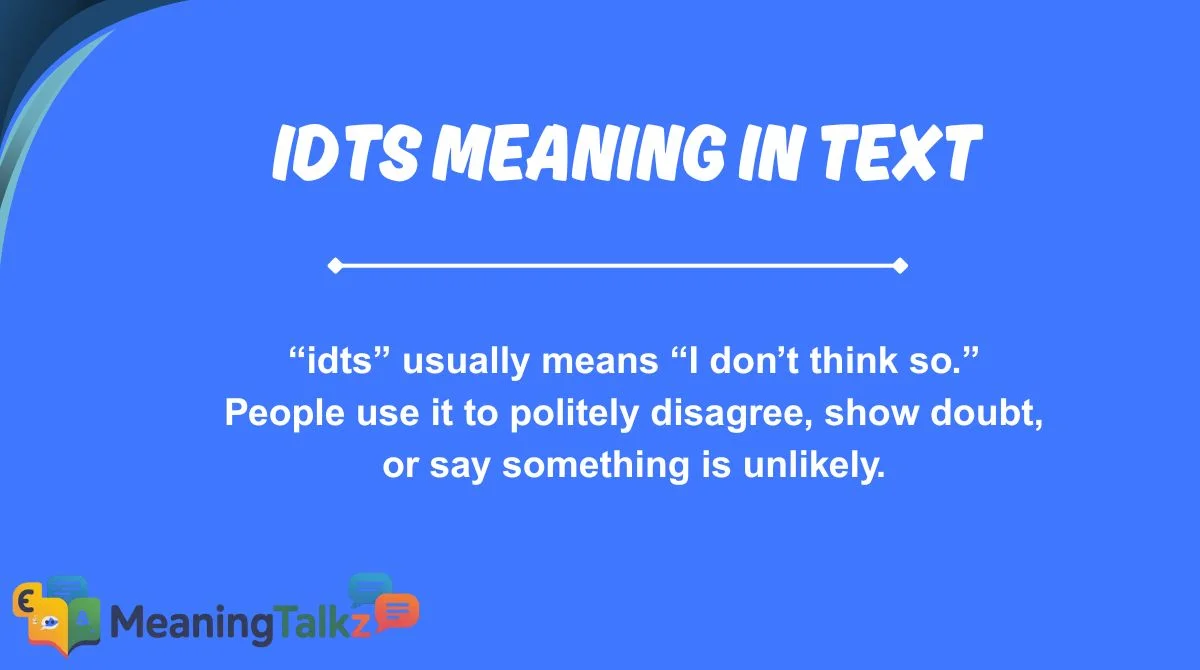
“idts” usually means “I don’t think so.”
People use it to politely disagree, show doubt, or say something is unlikely.
Other possible interpretations include:
- I doubt that
- Probably not
- That seems unlikely
- I’m not sure about that
The meaning usually depends on the conversation and tone.
IDTS vs. “No”: Is There a Difference?
Although IDTS can function like “no,” it usually leaves more room for uncertainty. Saying “no” can sound definite, while “I don’t think so” suggests that the sender believes the answer is probably no but is not claiming absolute certainty. For example, “Are they coming tonight?” → “idts” suggests they probably are not coming. “No, they’re not coming” sounds more certain. This distinction matters when reading short messages because IDTS can express a prediction, doubt, or disagreement rather than a firm fact. In some conversations, it can also work as a softer alternative to a direct refusal.
How Punctuation Changes the Tone of “IDTS”
The four letters themselves usually have the same meaning, but punctuation and surrounding text can change how they feel. A lowercase “idts” can sound casual and conversational, especially between friends. “IDTS.” may feel more firm or final, while “idts lol” can make the disagreement sound playful. In a tense conversation, the same abbreviation may come across as skeptical or dismissive. Because text does not provide facial expressions or vocal tone, readers often rely on punctuation, emojis, and the surrounding conversation to interpret the sender’s attitude.
The Most Common Meanings of “idts meaning in text”
Although the phrase is short, it can carry a few slightly different meanings depending on how someone uses it.
1. “I Don’t Think So”
This is the most common meaning of idts.
It simply shows that the person does not agree or does not believe something will happen.
Example:
Friend:
“Do you think the teacher will cancel the test?”
Reply:
“idts”
In this case, the person is saying they don’t think the test will be canceled.
It is not aggressive. It is just a quick opinion.
2. Expressing Doubt
Sometimes people use idts when they feel unsure or skeptical about something.
Example:
Friend:
“Jake said he finished the project in one hour.”
Reply:
“idts lol”
Here, the person thinks that claim is unlikely or exaggerated.
The “lol” softens the message.
3. Light Disagreement
Idts can also be used to disagree without starting an argument.
Example:
Friend:
“That movie was the best one this year.”
Reply:
“idts, the other one was better.”
Instead of saying “you’re wrong,” the person gives a softer disagreement.
4. Rejecting an Idea
Sometimes idts is simply a short way to say no.
Example:
Friend:
“Should we stay up all night gaming?”
Reply:
“idts, I’m tired.”
The person is politely rejecting the idea.
How “idts meaning in text” Is Used in Real Conversations
To understand slang properly, it helps to see how people actually use it online.
Friends & Casual Texting
Among friends, idts is extremely common.
It keeps conversations fast and relaxed.
Example:
“Do you think it will rain today?”
“idts”
“Is that new restaurant good?”
“idts tbh”
Friends usually understand the tone easily.
Instagram & Snapchat
On social platforms, people use idts when reacting to stories or messages.
Example:
“Is this outfit ugly?”
“idts, it looks good.”
“Do you think they will reply?”
“idts honestly.”
Because Instagram and Snapchat chats move quickly, short phrases like idts are very popular.
Dating Apps
In dating conversations, idts can appear in playful discussions or disagreements.
Example:
“Are you secretly a morning person?”
“idts lol.”
It often feels casual and light, especially if the person adds “lol” or “haha.”
However, if used alone, it may feel slightly blunt.
Gaming & Online Communities
Gamers often type very quickly during matches, so abbreviations dominate chat.
Example:
“Are we winning this round?”
“idts”
“Will the boss spawn now?”
“idts yet”
In gaming chats, people rarely type full sentences.
Speed matters more than tone.
Work or Professional Chat
This is where things change.
In professional communication, idts can feel too informal or careless.
Example:
Manager:
“Do you think the report will be ready today?”
Reply:
“idts”
This may sound short or unprofessional.
A better reply would be:
“I don’t think so. I may need more time.”
Is “idts meaning in text” Rude, Flirty, or Offensive?
The tone of idts depends almost completely on context and relationship.
Let’s break it down.
When It Feels Neutral
Most of the time, idts is neutral.
It simply expresses an opinion or doubt.
Example:
“Do you think they are open today?”
“idts”
There is no negative tone here.
When It Can Feel Slightly Rude
If idts is used alone with no explanation, it may sound dismissive.
Example:
“Do you like my idea?”
“idts”
This feels abrupt.
Adding a reason softens it:
“idts, but maybe we can try something else.”
When It Sounds Friendly
People often add extra words to make the tone friendly.
Examples:
- idts lol
- idts haha
- idts but maybe
- idts honestly
These small additions make the message feel warmer and more human.
When It Could Be Misinterpreted
Tone is hard to read in text.
Someone might send idts casually, but the reader may feel rejected or ignored.
That is why many people now add extra words or emojis to clarify tone.
How to Respond When Someone Says “idts meaning in text”
If someone replies with idts, you have several ways to respond depending on the situation.
Casual Replies
These work well in friendly chats.
Examples:
“Why not?”
“Really?”
“Okay, fair enough.”
“Maybe you’re right.”
Funny Replies
Humor can keep the conversation playful.
Examples:
“Wow, zero confidence in me.”
“Rude but okay.”
“You underestimate my power.”
This works best with friends.
Neutral Replies
Sometimes the best response is calm and simple.
Examples:
“Alright.”
“Good point.”
“Let’s see.”
These keep the conversation moving.
Professional Replies
In work conversations, respond more clearly.
Examples:
“Understood. What do you suggest instead?”
“Thanks for the feedback.”
“That makes sense.”
Professional chats require a more complete response.
Common Misunderstandings About “idts meaning in text”
Because idts is short, people often misunderstand it.
Here are the most common mistakes.
Thinking It Means “I Don’t Trust”
Some readers believe idts means “I don’t trust.”
This is incorrect.
The abbreviation almost always means “I don’t think so.”
Assuming It Is Rude
Many people think idts is aggressive.
In most cases, it is simply quick texting style, not disrespect.
Tone matters more than the word itself.
Confusing It With Similar Abbreviations
People sometimes mix idts with other slang.
Examples:
- idk – I don’t know
- imo – in my opinion
- istg – I swear to God
Each abbreviation has a different purpose.
Ignoring Context
The biggest misunderstanding is ignoring the context.
“idts” can mean different things depending on:
- The topic
- The relationship
- The platform
- The tone
Always read the full conversation.
Similar Slang Terms You Should Know
Modern texting is full of short phrases similar to idts.
Here are some common ones.
idk – I don’t know
imo – In my opinion
tbh – To be honest
ikr – I know, right
smh – Shaking my head
ngl – Not gonna lie
fr – For real
wyd – What are you doing
lmk – Let me know
brb – Be right back
omw – On my way
btw – By the way
Knowing these makes online chats much easier to understand.
When You Should Avoid Using “idts meaning in text”
Even though idts is common, it is not always appropriate.
Professional Settings
Work emails and business chats should avoid heavy slang.
Instead of idts, write:
“I don’t think that will work.”
Clear communication is better.
Cross-Cultural Conversations
Not everyone understands English texting slang.
Using idts with international contacts may create confusion.
It is safer to use full sentences.
Sensitive Situations
If someone shares something emotional, short replies can feel cold.
Example:
“I’m worried about my exam tomorrow.”
Replying with only “idts” might sound dismissive.
A better response:
“I don’t think you should worry. You prepared well.”
Final Thoughts.
Short internet slang like idts exists because people want to communicate quickly.
In most conversations, idts simply means “I don’t think so.”
It is a quick way to show doubt, disagreement, or uncertainty.
The tone depends on context. With friends, it feels normal. In professional chats, it may seem too casual.
The safest approach is simple:
- Use idts with friends or informal chats
- Avoid it in work conversations
- Add extra words if you want a friendlier tone
Understanding small slang terms like this helps you read messages correctly and avoid misunderstandings.
Modern texting moves fast, but once you learn the patterns, it becomes easy to follow.
FAQs
What does idts mean in text messages?
Idts usually means “I don’t think so.” People use it to express doubt or politely disagree with something.
Is idts rude in texting?
No. It is usually neutral. However, if used alone without explanation, it may sound slightly blunt.
What does idts mean on Snapchat or Instagram?
On social platforms, idts still means “I don’t think so.” It is often used in quick replies to stories or messages.
Is idts a Gen Z slang term?
Yes. It is widely used by Gen Z and online communities that prefer fast, short texting.
Can idts mean something else?
Rarely. In almost all cases, idts means “I don’t think so.” Context may slightly change the tone but not the core meaning.
Should you use idts in professional communication?
No. In work messages, it is better to write the full phrase “I don’t think so” to keep communication clear and professional.
How do you reply when someone says idts?
You can respond with questions, humor, or agreement. For example: “Why not?” “Maybe you’re right,” or “Okay, let’s see.”
Conclusion
Understanding the idts meaning in text helps you avoid confusion in modern conversations. The abbreviation simply stands for “I don’t think so,” and people use it to show doubt, disagreement, or uncertainty in a quick and casual way.
While it works well in friendly chats, social media, and gaming communities, it may sound too informal in professional settings. Context always matters.
If you remember that idts is just a fast way to share an opinion, you will read messages more accurately and respond with confidence.