You’re texting someone, and they suddenly reply: “DND.”
No smile, no explanation, just three letters.
Now you’re stuck wondering—did you say something wrong? Are they angry? Or are they just busy?
This is exactly why so many people search for dnd meaning in text every day. In modern chats, short forms and slang can feel confusing, especially when one phrase has more than one meaning depending on the situation.
“DND” is one of those terms that looks simple but can change the whole tone of a conversation. It can be used in casual texting, gaming chats, social media bios, and even professional settings.
In this guide, you’ll get a clear, no-confusion explanation of what DND means in text, how people use it, when it’s positive or negative, and how you should reply when someone sends it. By the end, you’ll never misunderstand it again.
What Does “DND” Mean in Text?
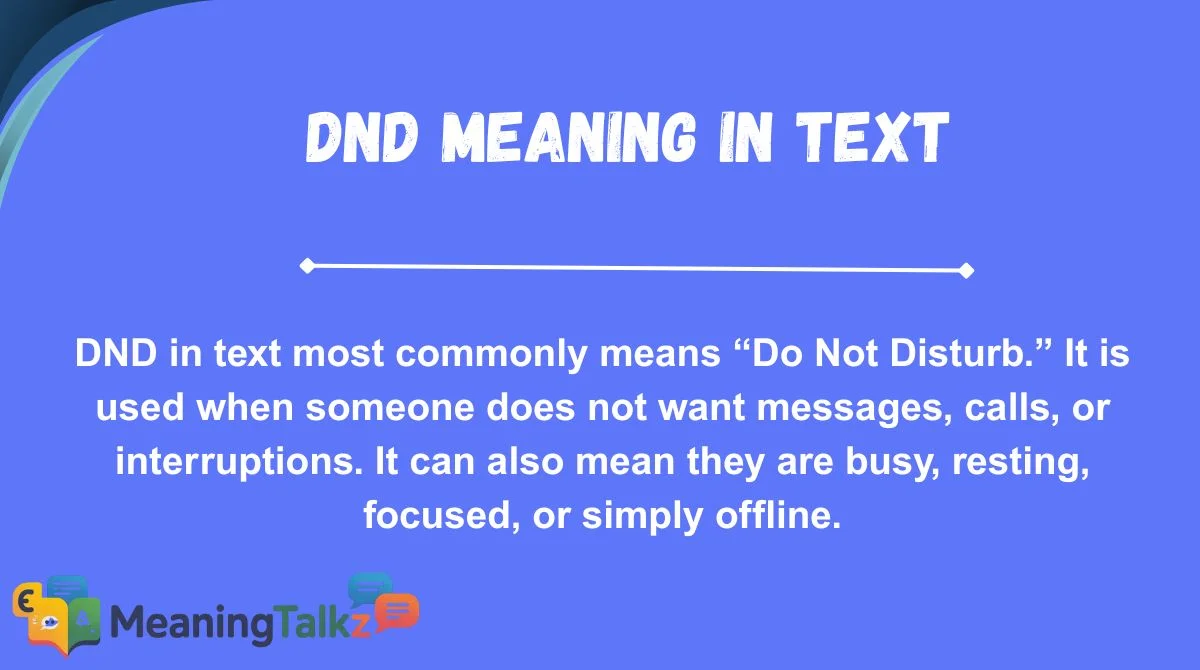
DND in text most commonly means “Do Not Disturb.” It is used when someone does not want messages, calls, or interruptions. It can also mean they are busy, resting, focused, or simply offline.
Other interpretations include “Dungeons & Dragons” in gaming communities and sometimes “Do Not Delete” in work or file contexts, but these are less common in everyday texting.
The Most Common Meanings of “DND” in Text
1. Do Not Disturb (Most Common Meaning)
This is the main meaning used in chats and smartphones.
When someone says DND, they usually mean:
- They are busy or working
- They don’t want to chat right now
- They are sleeping or resting
- They turned on phone silence mode
Example:
- “I’m on DND today, big exam tomorrow.”
2. Dungeons & Dragons (Gaming Meaning)
In gaming or nerd culture, DND can mean the famous role-playing game.
Used when:
- Talking about board games
- Discussing fantasy roleplay
- Gaming groups or Discord servers
Example:
- “We’re playing DND tonight, join if you want.”
3. Do Not Disturb Mode (Phone Setting)
Sometimes people refer to the phone feature itself.
Used when:
- Talking about silent mode
- Focus mode on iPhone/Android
Example:
- “My phone is on DND, I won’t hear calls.”
4. Do Not Delete (Rare Work Use)
In workplace chats or files, DND may mean something should not be removed.
Example:
- “This folder is DND, don’t delete it.”
How “DND” Is Used in Real Conversations
Friends & Casual Texting
In friend groups, DND is often used casually and without negative meaning.
Common uses:
- “DND for homework”
- “DND mood today”
- “Going DND, talk later”
It usually just means “I’m busy” or “I need space.”
Instagram & Snapchat
On social media, DND appears in bios, status updates, or stories.
Examples:
- “DND mode ✌️ exams week”
- “On DND, reply later”
- “Mental health DND day”
Here it signals boundaries or offline time.
Dating Apps
On dating platforms, DND can feel more personal.
It may mean:
- Not interested in chatting right now
- Taking a break from dating apps
- Busy in real life
Example:
- “On DND this week, will reply later.”
Tone matters a lot here. It can feel polite or distant depending on context.
Gaming & Online Communities
In Discord, gaming chats, and streaming communities, DND is extremely common.
Used for:
- Focus during gameplay
- Streaming mode
- Avoiding spam messages
Example:
- “Going DND during ranked match.”
Work or Professional Chat
In work environments, DND is used more formally.
It usually means:
- Focus time
- Meeting mode
- No interruptions allowed
Example:
- “I’m on DND until 3 PM, in meetings.”
Is “DND” Rude, Flirty, or Offensive?
DND is generally not rude or offensive. It is a neutral boundary-setting term.
When it feels positive:
- When someone explains it politely
- When used with emojis or friendly tone
- When it signals focus or self-care
Example:
- “DND today, need rest 😊”
When it feels negative:
- When used without explanation
- When it ends a conversation suddenly
- When tone feels cold or distant
Example:
- “DND.” (no context)
When it feels flirty (rare):
Sometimes in dating chats, DND can be playful:
- “On DND with you only 😉”
This depends fully on tone and relationship.
How to Respond When Someone Says “DND”
Casual Replies
- “Okay, talk later 👍”
- “No worries”
- “Got it, enjoy your time”
Funny Replies
- “I’ll respect the DND law 😂”
- “Even messages fear your DND mode”
- “Mission: not disturb accepted”
Neutral Replies
- “Alright, ping me when free”
- “Understood”
- “Will wait for your reply”
Professional Replies
- “Noted, I’ll reach out later”
- “Acknowledged, thank you”
- “I’ll follow up after your availability”
Common Misunderstandings About “DND”
1. Thinking it means anger or rejection
Many people assume DND means someone is mad. In reality, it usually just means they are busy.
2. Confusing it with “don’t disturb me personally”
It is not always emotional. Often it’s just a phone or focus setting.
3. Mixing it with unrelated slang
Some think DND means something romantic or hidden. That is incorrect in most cases.
4. Assuming it always means no communication allowed
People on DND may still reply later; it is not permanent silence.
Similar Slang Terms You Should Know
- BRB – Be Right Back
- AFK – Away From Keyboard
- IDC – I Don’t Care
- TTYL – Talk To You Later
- GTG – Got To Go
- IMO – In My Opinion
- FYI – For Your Information
- NVM – Never Mind
- IDCY – I Don’t Care Yet (informal)
- LMAO – Laughing My Ass Off
- IYKYK – If You Know, You Know
- OOO – Out Of Office
When You Should Avoid Using “DND”
Professional Settings
In formal emails or client communication, it’s better to say:
- “I am currently unavailable”
- “In focus mode until later”
Cross-cultural chats
Not everyone understands slang. DND may confuse international users.
Sensitive situations
Avoid using DND when someone expects urgent communication, like emergencies or important updates.
Final Thoughts
DND is one of the simplest yet most misunderstood chat abbreviations. At its core, it means Do Not Disturb, a polite way of saying someone is busy, resting, or focusing.
It is not rude, not emotional by default, and not meant to create distance. It is simply a modern way to set boundaries in a digital world full of notifications and constant messages.
Once you understand the context, DND becomes easy to interpret—and even easier to use correctly in your own conversations.
FAQs
What does DND mean in texting?
It means “Do Not Disturb,” usually showing someone is busy or offline.
Is DND rude in chat?
No, it is neutral. It only depends on tone and context.
Can DND mean something else?
Yes, it can also mean “Dungeons & Dragons” in gaming contexts.
Why do people use DND status?
To avoid interruptions, focus on work, or take a break.
Is DND the same as silent mode?
Not exactly, but it often refers to the phone’s Do Not Disturb mode.
What should I reply to DND?
Simple replies like “okay” or “talk later” are best.
Does DND mean ignoring someone?
Not usually. It typically means temporary unavailability.
Conclusion
DND in text is a modern digital shortcut for managing attention and communication.
Whether used in casual chats, social media, or work, it mainly signals one thing: the person needs space or focus.
Understanding this helps avoid confusion, overthinking, and misinterpretation in everyday messaging.