You’re texting someone. Everything is going normal. Then suddenly they reply with just three letters:
“IDM.”
Now you pause.
Did they mean something rude?
Is it slang?
Is it a typo?
Or is it something only Gen Z understands?
Moments like this are exactly why people search “what does IDM mean in text.” Short slang terms appear everywhere now—texts, Instagram comments, Snapchat chats, gaming lobbies, and even work messages.
If you don’t know the meaning, the conversation can quickly feel confusing.
The problem is that IDM can mean different things depending on the situation. Sometimes it’s polite. Sometimes it shows indifference.
In other cases, it simply means someone is fine with whatever choice you make.
This guide breaks everything down in clear, simple language. You’ll learn:
- The real meaning of IDM in texting
- Where people use it online
- How tone changes its meaning
- How to respond correctly
- Common misunderstandings to avoid
By the end, you’ll never feel confused when someone texts IDM again.
What Does “IDM” Mean in Text?
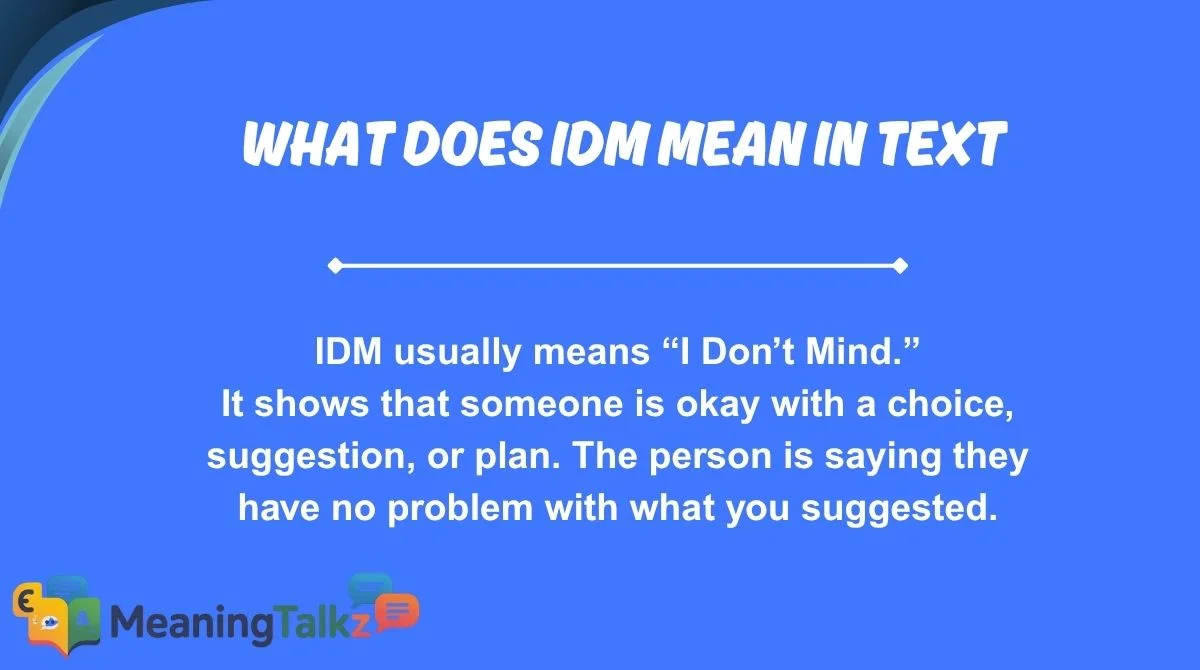
IDM usually means “I Don’t Mind.”
It shows that someone is okay with a choice, suggestion, or plan. The person is saying they have no problem with what you suggested.
Depending on the conversation, IDM can also mean:
- I Don’t Matter
- It Doesn’t Matter
- Instant Direct Message (rare online usage)
Most of the time, though, when someone texts IDM, they simply mean “I’m fine with it.”
The Most Common Meanings of “IDM”
Even though IDM is short, it can carry slightly different meanings depending on the situation.
1. I Don’t Mind (Most Common Meaning)
This is the meaning used in most conversations.
It tells the other person you agree or have no preference.
Example:
Friend:
“Should we watch a movie or play a game?”
Reply:
“IDM.”
The message means either option is fine.
Another example:
“IDM if we go later.”
This shows flexibility and politeness.
2. It Doesn’t Matter
Sometimes IDM means the choice is not important to the person.
Example:
“IDM what restaurant we choose.”
Here the person is saying the decision does not matter much to them.
It’s still polite but shows low preference.
3. I Don’t Matter
This meaning appears less often but can show sadness or frustration.
Example:
“I guess IDM anyway.”
In this case, the person might feel ignored or unimportant.
Tone matters a lot here.
4. Instant Direct Message (Rare Meaning)
In some online discussions, IDM may mean Instant Direct Message.
Example:
“Send me an IDM on Instagram.”
However, this version is not very common today.
How “IDM” Is Used in Real Conversations
Slang changes slightly depending on the platform. Let’s see how IDM appears in everyday messages.
Friends & Casual Texting
Among friends, IDM usually shows easygoing agreement.
Examples:
“Want pizza tonight?”
“IDM.”
“Should we meet at 7?”
“IDM.”
Friends use it when they don’t care about small decisions.
It keeps conversations short and relaxed.
Instagram & Snapchat
On social media chats, IDM often appears in quick replies.
Examples:
“Can I post that picture?”
“IDM.”
“Mind if I tag you?”
“IDM.”
Here the meaning is still “I don’t mind.”
People use it because it saves time.
Dating Apps
On dating apps, IDM can show casual interest or flexibility.
Example:
“Coffee or dinner?”
“IDM, you choose.”
This response can signal the person is easygoing.
But sometimes it may also feel like they’re not very invested, depending on tone.
Gaming & Online Communities
Gamers use IDM when discussing team choices or strategies.
Example:
“Should we change maps?”
“IDM.”
“Want to play another round?”
“IDM.”
It means the player is okay with whatever the group decides.
Work or Professional Chat
In work chats, IDM can still appear but less often.
Example:
“Can we move the meeting to 3 PM?”
“IDM.”
In professional environments, people may prefer slightly clearer wording like:
“I don’t mind moving the meeting.”
Still, the meaning remains polite and cooperative.
Is “IDM” Rude, Flirty, or Offensive?
Most of the time, IDM is neutral and polite.
But tone changes how people feel about it.
When IDM Feels Positive
IDM feels friendly when someone is simply being flexible.
Example:
“Should we hang out tomorrow or Friday?”
“IDM.”
Here it shows easygoing energy.
When IDM Feels Neutral
Sometimes IDM just shows no strong opinion.
Example:
“What movie should we watch?”
“IDM.”
This response is normal and not emotional.
When IDM Feels Negative
In some cases, IDM may feel disinterested or distant.
Example:
“Do you want to come to the party?”
“IDM.”
The reply might sound like the person doesn’t really care.
When IDM Feels Passive-Aggressive
Rarely, IDM can hide frustration.
Example:
“Should we cancel the plan?”
“IDM.”
If the conversation was tense before, this reply might signal annoyance or giving up.
Context always matters.
How to Respond When Someone Says “IDM”
Your response should match the conversation tone.
Here are different ways to reply.
Casual Replies
When talking with friends, keep it relaxed.
Examples:
“Alright cool.”
“Okay, let’s do that then.”
“Nice, works for me.”
These replies keep the conversation moving.
Funny Replies
If the vibe is playful, humor works well.
Examples:
“Great, decision power unlocked.”
“Okay, I’ll choose wisely.”
“Responsibility accepted.”
Funny responses keep texting fun.
Neutral Replies
Sometimes you just want to continue the plan.
Examples:
“Cool, let’s meet at 7 then.”
“Alright, we’ll go with that.”
“Sounds good.”
These replies confirm the decision.
Professional Replies
In work chats, slightly clearer wording helps.
Examples:
“Great, thank you.”
“Perfect, I’ll schedule it.”
“Appreciate the flexibility.”
This keeps communication professional.
Common Misunderstandings About “IDM”
Many people misread this short slang term.
Here are common mistakes.
Thinking It Means “Ignore Direct Message”
Some people assume IDM relates to ignoring messages.
That meaning is incorrect.
IDM usually means I Don’t Mind.
Confusing It With DM
Another mistake is mixing it with DM (Direct Message).
DM refers to private messages on social media.
IDM is completely different.
Reading It As Rudeness
Because IDM is short, it can look cold.
But usually it’s just quick texting style.
People often shorten phrases to save time.
Misreading Emotional Tone
Without voice or facial expression, text can feel unclear.
“IDM.” might sound bored, but the sender may simply be busy or typing quickly.
Similar Slang Terms You Should Know
Modern texting is full of short phrases like IDM. Here are related terms people use.
IDC
Means “I Don’t Care.” Often stronger than IDM.
IDK
Means “I Don’t Know.”
IMO
Means “In My Opinion.”
TBH
Means “To Be Honest.”
IKR
Means “I Know, Right?”
NVM
Means “Never Mind.”
BRB
Means “Be Right Back.”
SMH
Means “Shaking My Head.”
FOMO
Means “Fear Of Missing Out.”
LMK
Means “Let Me Know.”
NP
Means “No Problem.”
Learning these makes texting much easier.
When You Should Avoid Using “IDM”
Even though IDM is common, there are moments when it’s better to skip it.
Professional Settings
Some workplaces prefer clear language.
Instead of writing:
“IDM.”
You could write:
“I don’t mind moving the meeting.”
This avoids confusion.
Cross-Cultural Conversations
Not everyone understands internet slang.
Using IDM with someone unfamiliar with texting shortcuts might confuse them.
Sensitive Situations
If someone is discussing something serious, IDM might feel dismissive.
Example:
“Is it okay if we cancel the project?”
Replying with IDM might sound like you don’t care.
Clear responses work better in serious moments.
Final Thoughts
If you ever see IDM in a message, the meaning is usually simple.
It stands for “I Don’t Mind.”
People use it to show they are fine with a suggestion, decision, or plan. It’s a short way to say they have no problem with the choice.
Like many texting shortcuts, the meaning can change slightly depending on tone and context. Sometimes it sounds friendly and flexible. Other times it may feel neutral or uninterested.
The key is to look at the full conversation, not just the three letters.
Once you understand the context, IDM becomes one of the easiest slang terms to recognize.
Knowing small phrases like this helps you navigate modern texting, social media chats, and online conversations with confidence.
FAQs
What does IDM mean in texting?
IDM usually means “I Don’t Mind.” It shows someone is okay with a choice or suggestion.
Is IDM rude in text messages?
No, IDM is usually neutral or polite. It simply shows someone has no preference.
What is the difference between IDM and IDC?
IDM means “I Don’t Mind,” while IDC means “I Don’t Care.” IDC can sound more negative.
Do people use IDM on Instagram or Snapchat?
Yes. Many people use IDM in social media chats to quickly say they’re okay with something.
Can IDM mean “It Doesn’t Matter”?
Yes. In some contexts IDM can mean “It Doesn’t Matter,” though “I Don’t Mind” is more common.
Is IDM used by Gen Z?
Yes. Gen Z and younger internet users often use short texting phrases like IDM.
Should I use IDM in professional messages?
It’s better to write the full phrase “I don’t mind” in formal or professional communication.
Conclusion
Short slang terms can make texting confusing, especially when you see them for the first time. But IDM is actually one of the simplest internet abbreviations.
In most conversations, it just means “I Don’t Mind.” The person is saying they’re comfortable with the idea or decision being discussed.
Whether you see IDM in texts, social media chats, gaming conversations, or casual work messages, the key is understanding the context and tone around it.
Once you know the meaning, IDM becomes a quick and helpful way to keep conversations smooth and flexible.