You open a message and see just two letters: “PU.”
Now you pause.
Did they mean something rude? Are they joking? Is it slang? Or maybe a typo?
Short text slang like this shows up everywhere today — in Snapchat, Instagram DMs, gaming chats, dating apps, and even normal texting.
Because people want to type faster, they shorten words into tiny pieces like “PU,” “HMU,” or “BRB.”
That’s exactly why so many people search for “pu meaning in text.” Two letters can mean different things depending on the conversation.
Sometimes it’s playful. Sometimes it means something smells bad. And sometimes it’s just casual internet slang between friends.
If you misunderstand it, you might reply the wrong way.
This guide explains exactly what “PU” means in text messages, how people actually use it online, and how to respond without sounding confused.
By the end, you’ll understand every common meaning, when people use it, and when you should avoid using it yourself.
Let’s break it down.
What Does “PU Meaning in Text” Mean in Text?
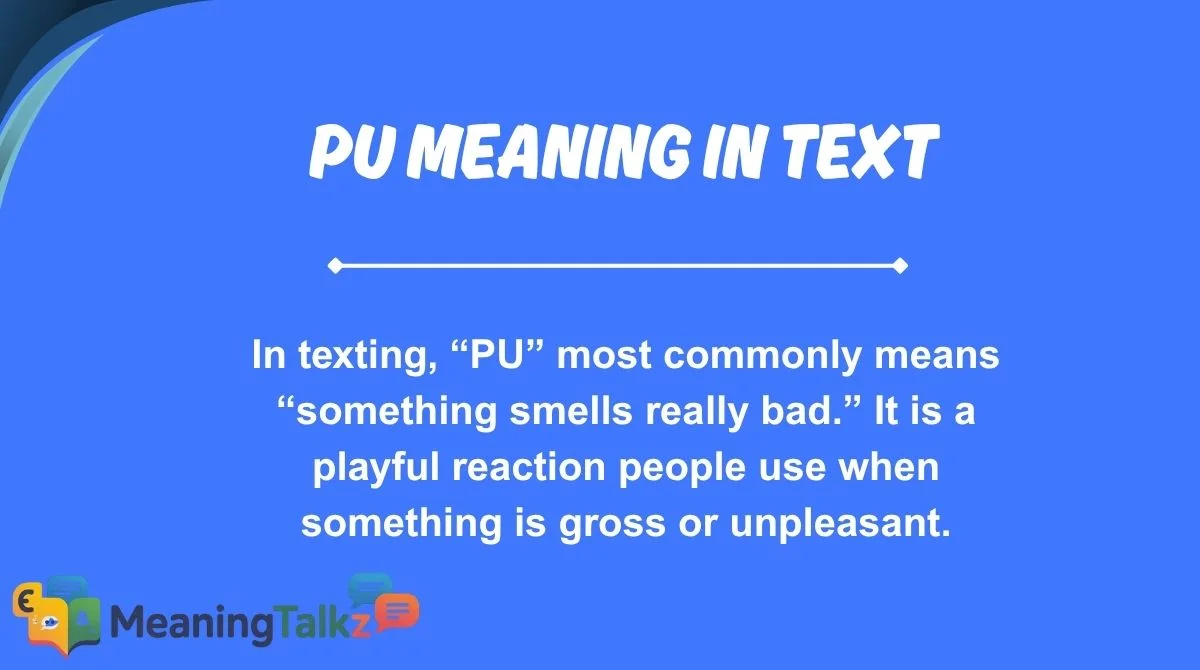
In texting, “PU” most commonly means “something smells really bad.” It is a playful reaction people use when something is gross or unpleasant.
However, depending on the chat, PU can also mean:
- A joking reaction to something disgusting
- A short form of “pick up” in some messages
- A sarcastic reaction to bad news or awkward moments
Most of the time, though, PU simply means “that smells bad” or “yuck.”
The Most Common Meanings of “PU”
Even though it’s short, PU has several meanings in texting culture. Context matters a lot.
Here are the meanings you’ll see most often.
1. Something Smells Bad
This is the most common meaning.
“PU” is a reaction to something that smells terrible or feels gross. It works like saying “ew.”
Example:
Friend: “I forgot my lunch in my bag for 2 days.”
You: “PU that must smell awful.”
Another example:
“PU your gym socks must be dangerous.”
It’s usually used in a funny or playful way, not a serious insult.
2. A Reaction to Something Gross
Sometimes “PU” is used even when there is no real smell. It just means something is disgusting.
Example:
Friend: “He drank milk that expired last week.”
You: “PU that’s nasty.”
Example:
“That food combo sounds wild. PU.”
In this case, the person is reacting emotionally, not literally smelling something.
3. Short for “Pick Up”
In some texts, PU can mean “pick up.”
This appears mostly in quick logistics messages.
Example:
“Can you PU milk on the way home?”
Example:
“I’ll PU the kids after practice.”
Here, it simply saves typing time.
4. Sarcastic Reaction
Some people use “PU” when reacting to something unpleasant, awkward, or disappointing.
Example:
Friend: “My boss just scheduled a meeting for 7 AM.”
You: “PU that’s rough.”
This use is less common but still seen.
How “PU” Is Used in Real Conversations
Different platforms create different slang styles. Let’s see how PU appears in everyday online chats.
Friends & Casual Texting
This is where the slang appears the most.
Friends often use “PU” in a joking or dramatic way.
Example conversation:
Friend: “I burned the pizza again.”
You: “PU the kitchen must smell mistaken.”
Example:
Friend: “I forgot to shower after the gym.”
You: “PU stay away from me.”
It’s playful teasing between friends.
Instagram & Snapchat
Short reactions are common on social media.
“PU” might appear as a quick reply to stories or snaps.
Example responses:
“PU that food combo looks wild.”
“PU that locker room must smell bad.”
Because Snapchat messages are fast and casual, short slang like PU fits perfectly.
Dating Apps
On dating apps, the tone matters more.
“PU” can still appear, but usually as a light joke.
Example:
Match: “I tried cooking and burned everything.”
Reply: “PU sounds like a smoky kitchen.”
However, if used wrong, it may seem rude.
Example of bad use:
“PU your cooking skills.”
That could sound insulting.
Gaming & Online Communities
Gamers use “PU” mostly as a reaction to something unpleasant.
Example:
“PU that boss fight was brutal.”
Example:
“PU that server lag is terrible.”
In gaming chats, short reactions help keep the game moving.
Work or Professional Chat
In professional messages, PU is rare.
Using slang like this can feel unprofessional.
Example of better wording:
Instead of:
“PU that report looks messy.”
Say:
“Let’s review the report formatting.”
So in work chats, it’s best to avoid slang like PU.
Is “PU” Rude, Flirty, or Offensive?
The tone of PU depends entirely on context.
Most of the time, it is not rude.
It’s usually playful.
When It Feels Positive
PU can feel friendly when:
- Used jokingly with friends
- Reacting to funny stories
- Teasing someone you know well
Example:
“PU your room must be dangerous.”
That sounds like playful teasing.
When It Feels Negative
PU can feel rude if:
- Said directly about someone
- Used with strangers
- Used to insult someone’s appearance or smell
Example:
“PU you smell bad.”
That sounds offensive.
When It Feels Flirty
Sometimes people use “PU” in teasing flirting.
Example:
“PU you’re making me jealous.”
But this is rare. Most flirting slang uses other terms instead.
How to Respond When Someone Says “PU”
If someone texts “PU,” the right reply depends on tone.
Here are some simple ways to respond.
Casual Replies
These work best with friends.
Examples:
“Yeah it’s pretty bad.”
“Don’t judge me.”
“I know it smells mistaken.”
“You’re not wrong.”
Funny Replies
Humor works well here.
Examples:
“Send help.”
“It’s a biological weapon.”
“I might move houses.”
“Call the smell police.”
Neutral Replies
Use these when you’re unsure of tone.
Examples:
“Yeah it’s not great.”
“I’ll fix it.”
“Good point.”
“I noticed that too.”
Professional Replies
If this somehow appears in work chat, keep your response simple.
Examples:
“Let’s review it.”
“I’ll update that.”
“Thanks for pointing it out.”
Avoid slang replies in professional conversations.
Common Misunderstandings About “PU”
Many people misunderstand this slang because it is so short.
Here are the most common mistakes.
Thinking It Always Means Insult
Not true.
Most of the time, PU is just playful exaggeration.
Friends use it jokingly.
Confusing It With “P.U.”
Sometimes people write it with periods like this:
“P.U.”
That version comes from older comic-style expressions meaning “bad smell.”
Both versions mean the same thing.
Thinking It Means Something Romantic
PU rarely has romantic meaning.
Most of the time it’s just a reaction like “ew.”
Misreading the Tone
Tone in text can be tricky.
Without context, “PU” might look rude even if the sender meant it as a joke.
That’s why relationship context matters.
Similar Slang Terms You Should Know
If you’re learning texting slang, here are other common short reactions.
1. LOL
Means “laughing out loud.”
2. BRB
Means “be right back.”
3. SMH
Means “shaking my head.”
4. IMO
Means “in my opinion.”
5. TBH
Means “to be honest.”
6. IDK
Means “I don’t know.”
7. OMG
Means “oh my goodness.”
8. ICK
Used when something feels gross or awkward.
9. EW
Another reaction to something disgusting.
10. YIKES
Reaction to something shocking or embarrassing.
11. SUS
Means something seems suspicious.
12. NAH
Casual way to say “no.”
These slang terms appear across texting, gaming, and social media.
When You Should Avoid Using “PU”
Even though it’s harmless most of the time, PU isn’t always appropriate.
Here are situations where it’s better not to use it.
Professional Settings
Avoid slang in:
- Work emails
- Business messages
- Client chats
It can look immature.
Cross-Cultural Conversations
Some people may not understand the slang.
This could create confusion.
Using clear language is safer.
Sensitive Situations
Never use “PU” when someone is sharing something serious.
Example situations:
- Health issues
- Personal struggles
- Emotional topics
It may sound insensitive.
Final Thoughts.
The PU meaning in text is simple once you know the context.
Most of the time, PU is just a playful way to say something smells bad or feels gross. Friends use it jokingly when reacting to funny or unpleasant situations.
Sometimes it also appears as a shortcut for “pick up,” especially in quick messages about errands.
The key thing to remember is tone and relationship. Among friends, PU is harmless and often funny. In professional or unfamiliar conversations, it’s better to avoid slang like this.
Now when you see PU in a text message, you won’t feel confused. You’ll instantly know whether someone is joking, reacting to something gross, or simply talking about picking something up.
Understanding small slang like this makes online conversations much easier.
FAQs
What does PU mean in texting?
PU usually means something smells bad or feels disgusting. People use it as a playful reaction similar to saying “ew.”
Does PU mean pick up in messages?
Yes. In some conversations, PU is short for “pick up.” Example: “Can you PU groceries?”
Is PU rude in text messages?
Not usually. Among friends it’s playful. But if used directly about a person, it may sound insulting.
Do people still say PU in 2026 texting?
Yes, but mostly in casual chats. It appears in texts, gaming chats, and social media replies.
What is the difference between PU and ew?
Both express disgust. PU often refers to bad smells, while “ew” can react to anything gross.
Can PU be used on social media?
Yes. People sometimes comment “PU” when reacting to unpleasant or funny posts.
Should I use PU in professional messages?
No. It’s better to avoid slang in work communication.
Conclusion
Short slang like PU shows how fast online language evolves. Two small letters can carry tone, humor, and reaction all at once. In most cases, PU simply signals that something smells bad or feels gross, often in a playful way.
The trick to understanding it is context. Look at the conversation, the relationship with the sender, and the platform where the message appears. Among friends, it’s harmless fun. In formal settings, it’s better left out.
Now that you know the full PU meaning in text, you can read messages with confidence and reply naturally without second-guessing what those two little letters mean.