You’re texting someone. Everything feels normal. Then suddenly they reply with “GTFO.”
Now you pause.
Are they joking?
Are they mad?
Did you just say something wrong?
This exact moment is why thousands of people search “gtfo meaning in text” every day. Slang on the internet moves fast. What once sounded aggressive can now be funny, sarcastic, or even friendly depending on the situation.
In today’s texting culture—especially among Gen Z and online communities—short acronyms like GTFO are everywhere. You’ll see them on Snapchat, Instagram DMs, gaming chats, and even group texts with friends.
But here’s the tricky part: GTFO can mean different things depending on tone, context, and who is saying it.
In this guide, you’ll learn exactly what GTFO means in text, how people actually use it in conversations, when it sounds playful vs rude, and how to respond without making things awkward.
By the end, you’ll understand this slang like a native internet speaker.
What Does “GTFO Meaning in Text” Mean in Text?
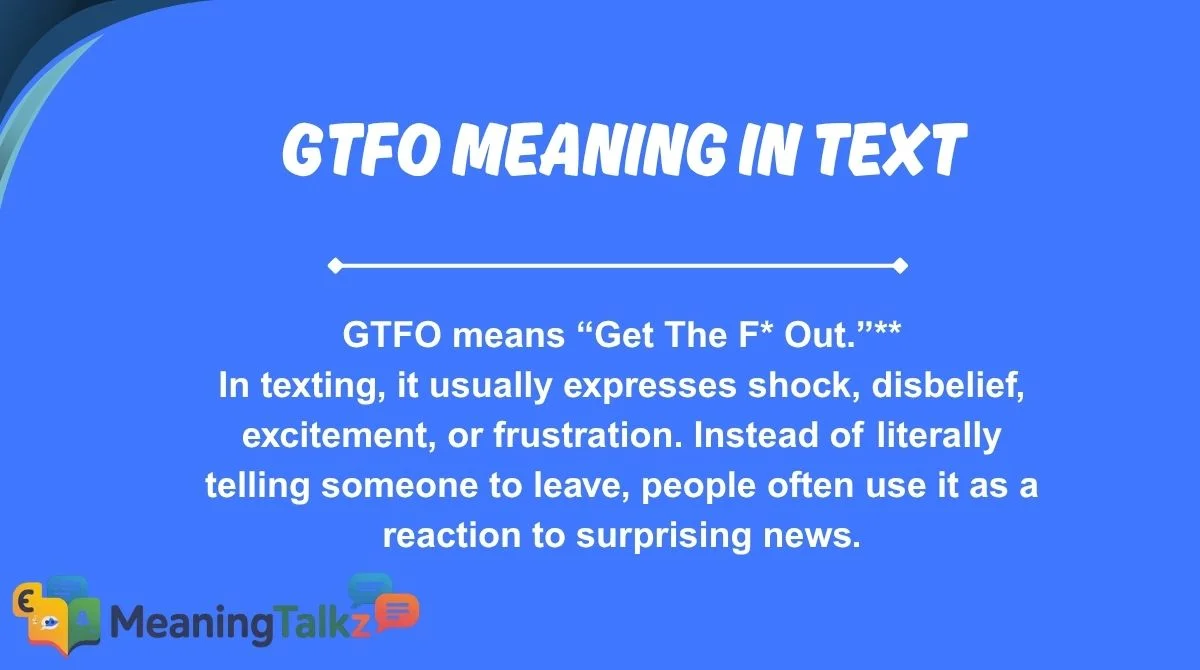
GTFO means “Get The F* Out.”**
In texting, it usually expresses shock, disbelief, excitement, or frustration. Instead of literally telling someone to leave, people often use it as a reaction to surprising news.
Common interpretations include:
- Being shocked by surprising information
- Reacting to something funny or unbelievable
- Showing annoyance or anger
- Playfully telling someone to stop joking
The exact tone depends heavily on the conversation.
The Most Common Meanings of “GTFO Meaning in Text”
1. Shock or Disbelief
One of the most common uses of GTFO is reacting to surprising news.
People use it when they hear something hard to believe.
Example:
Friend:
“I just met my favorite singer at the mall.”
Reply:
“GTFO. No way.”
Here, GTFO means “you’re kidding me.”
It shows excitement and disbelief rather than anger.
2. Playful Reaction Between Friends
Among close friends, GTFO can simply mean:
“Stop playing.”
Example:
Friend:
“I ate your snacks again.”
Reply:
“GTFO bro.”
In this context, it’s joking. No one is actually offended.
3. Annoyance or Frustration
Sometimes the phrase is used in a more serious tone.
Example:
“GTFO with that nonsense.”
Here the message shows clear frustration or disagreement.
The person wants the other person to stop saying something.
4. Genuine Anger
In rare cases, GTFO is literal.
Example:
“GTFO of my house.”
This version is direct and aggressive. It means someone is angry.
However, in texting culture this use is less common than playful reactions.
How “GTFO Meaning in Text” Is Used in Real Conversations
Friends & Casual Texting
This is where GTFO appears most often.
Friends use it to react dramatically to stories, gossip, or jokes.
Example conversation:
Friend 1:
“I just saw your ex with someone new.”
Friend 2:
“GTFO really??”
Tone here = shock.
Another example:
Friend:
“You still owe me pizza.”
Reply:
“GTFO I bought last time.”
Tone here = playful argument.
Instagram & Snapchat
On social media, GTFO usually appears in reactions.
People use it when responding to surprising posts or stories.
Examples:
“GTFO that outfit is nonsensical.”
“GTFO you met him??”
“GTFO I’m jealous.”
In these cases the slang acts like saying:
“No way!”
Dating Apps
On dating apps, the meaning depends strongly on tone.
Playful example:
Match:
“I can cook better than any restaurant.”
Reply:
“GTFO prove it.”
This feels teasing.
But if used aggressively, it can come across as rude.
Example:
“GTFO if you’re going to act like that.”
Tone here = rejection or frustration.
Gaming & Online Communities
Gaming culture helped make GTFO widely popular.
Players use it when reacting to mistaken gameplay moments.
Example:
Player:
“I just got a legendary drop.”
Team chat:
“GTFO lucky!”
Other gaming examples:
“GTFO that boss was easy.”
“GTFO you cheated.”
Most of the time the tone is competitive but humorous.
Work or Professional Chat
In professional settings, GTFO is rarely appropriate.
Work chats usually avoid profanity.
Even if meant jokingly, it may appear disrespectful.
Example of what NOT to send:
“GTFO that deadline changed again?”
Instead, people say:
“No way.”
“Seriously?”
“Wow, I didn’t expect that.”
Is “GTFO Meaning in Text” Rude, Flirty, or Offensive?
The tone of GTFO depends on three main factors.
1. Relationship Between People
Close friends understand sarcasm.
Strangers might misunderstand it.
Example:
Friend says:
“GTFO that’s wild.”
This feels funny.
But if a stranger says the same thing, it might feel aggressive.
2. Message Context
The surrounding words change the tone.
Friendly example:
“GTFO that’s amazing.”
Negative example:
“GTFO with that attitude.”
One feels excited. The other feels insulting.
3. Platform Culture
Some online spaces use stronger slang regularly.
Gaming servers, meme pages, and group chats tolerate phrases like GTFO.
Professional chats usually do not.
How to Respond When Someone Says “GTFO Meaning in Text”
If someone texts GTFO, your reply depends on the mood of the conversation.
Casual Replies
These work when the tone is friendly.
Examples:
“I’m serious.”
“Swear it’s true.”
“Yep it happened.”
Funny Replies
Humor works well with playful slang.
Examples:
“Calm down detective.”
“I knew you’d react like that.”
“Believe it or not.”
Neutral Replies
If you’re unsure about tone, keep the reply simple.
Examples:
“Yeah it surprised me too.”
“I couldn’t believe it either.”
“mistakenright?”
Professional Replies
In rare cases where it appears in work chat, keep the response polite.
Examples:
“That’s surprising.”
“I’ll double check the information.”
“Let me confirm that.”
Common Misunderstandings About “GTFO Meaning in Text”
Thinking It Always Means Anger
Many people assume GTFO is always hostile.
But online, it often expresses excitement or disbelief.
Example:
“GTFO you won the contest?”
That is positive.
Confusing It With a Literal Command
Some people read it as an actual order to leave.
In most texting contexts, it simply means:
“No way.”
Ignoring Tone Markers
Words around the acronym change everything.
Compare:
“GTFO that’s hilarious.”
vs
“GTFO with that attitude.”
Same slang, different emotion.
Similar Slang Terms You Should Know
Here are common internet reactions similar to GTFO.
OMG – Shows surprise or excitement.
WTF – Expresses shock or confusion.
LMAO – Means laughing extremely hard.
BRUH – Reaction to something ridiculous.
NO WAY – Direct disbelief.
IKR – Means “I know, right.”
SMH – Shows disappointment or disbelief.
FR – Means “for real.”
CAP – Means someone is lying.
NO CAP – Means someone is telling the truth.
BRO WHAT – Shocked reaction to something strange.
STOPPP – Playful disbelief or excitement.
These reactions appear frequently in texting and social media.
When You Should Avoid Using “GTFO Meaning in Text”
Even though the slang is popular, some situations require caution.
Professional Settings
Work chats, emails, and business communication should stay polite.
Avoid profanity-based acronyms.
Cross-Cultural Conversations
Not everyone understands internet slang.
Some people may take GTFO literally, which can cause confusion.
Sensitive Situations
Serious discussions require respectful language.
Example topics:
- personal problems
- conflict
- emotional conversations
In these cases, slang can seem dismissive.
Final Thoughts.
Understanding gtfo meaning in text is simple once you know the context.
The phrase technically means “Get The F* Out.”** But in most online conversations it’s not meant literally.
Instead, people use it to react to surprising, funny, or unbelievable moments.
Among friends, it usually feels playful. In heated arguments, it can sound rude. And in professional settings, it’s best avoided entirely.
Like many internet slang terms, tone and relationship matter more than the words themselves.
Once you understand the context, reading messages like GTFO becomes easy—and you’ll never have to pause in confusion again.
FAQs
What does GTFO mean in texting?
GTFO stands for “Get The F* Out.”** In texting it often expresses shock, disbelief, or playful reaction rather than a literal command.
Is GTFO rude in messages?
It can be rude if used aggressively. However, among friends it is often used jokingly or sarcastically.
Does GTFO always mean anger?
No. Many people use it to react to surprising or unbelievable news.
Is GTFO appropriate for work chats?
No. Because it contains profanity, it is not suitable for professional communication.
What is the difference between GTFO and WTF?
GTFO usually reacts to surprising information, while WTF expresses confusion or disbelief about a situation.
Can GTFO be used in a funny way?
Yes. Friends often use it humorously when reacting to jokes or unbelievable stories.
Do younger people use GTFO often?
Yes. It appears frequently in texting, gaming chats, and social media conversations among younger internet users.
Conclusion
Internet slang evolves constantly, and GTFO is a perfect example of how meaning depends on context.
While the phrase literally means “Get The F*** Out,” most people use it as a reaction to shocking, funny, or unbelievable moments in conversation.
Among friends it usually feels playful. In arguments it can sound harsh. And in professional spaces it’s best avoided completely.
The key is reading the tone, relationship, and platform before reacting. Once you understand that, interpreting slang like GTFO becomes effortless.
Learning these texting expressions helps you communicate clearly, avoid misunderstandings, and stay fluent in modern online language.